

The Christmas shearwater or ʻaoʻū is a medium-sized shearwater of the tropical Central Pacific. It is a poorly known species due to its remote nesting habits, and it has not been extensively studied at sea either.
Region
Central Pacific Ocean
Typical Environment
Occurs widely across tropical Central Pacific waters, with breeding colonies on remote low coral islands and atolls. Notable colonies include islands in the Line and Phoenix Islands and the Northwestern Hawaiian Islands. At sea it ranges over warm pelagic waters far from shore, typically foraging along current edges and areas of localized upwelling. Breeding sites are on sparsely vegetated dunes, coral rubble, or rocky ledges where it uses burrows, cavities, or cover under shrubs. Outside the breeding season it disperses broadly across the tropical ocean but remains in warm-water zones.
Altitude Range
Sea level to 200 m
Climate Zone
Tropical
Ease of Keeping
Beginner friendly: 1/5
The Christmas shearwater spends most of its life far from land, returning to remote islands only to breed. It attends colonies mainly at night to avoid predators, which makes it difficult to study. Breeding pairs are long-lived and typically raise a single chick per season. Introduced predators and light pollution near colonies can negatively affect chicks and adults.


Breeding adult with its single egg, Eastern Island of Midway Atoll
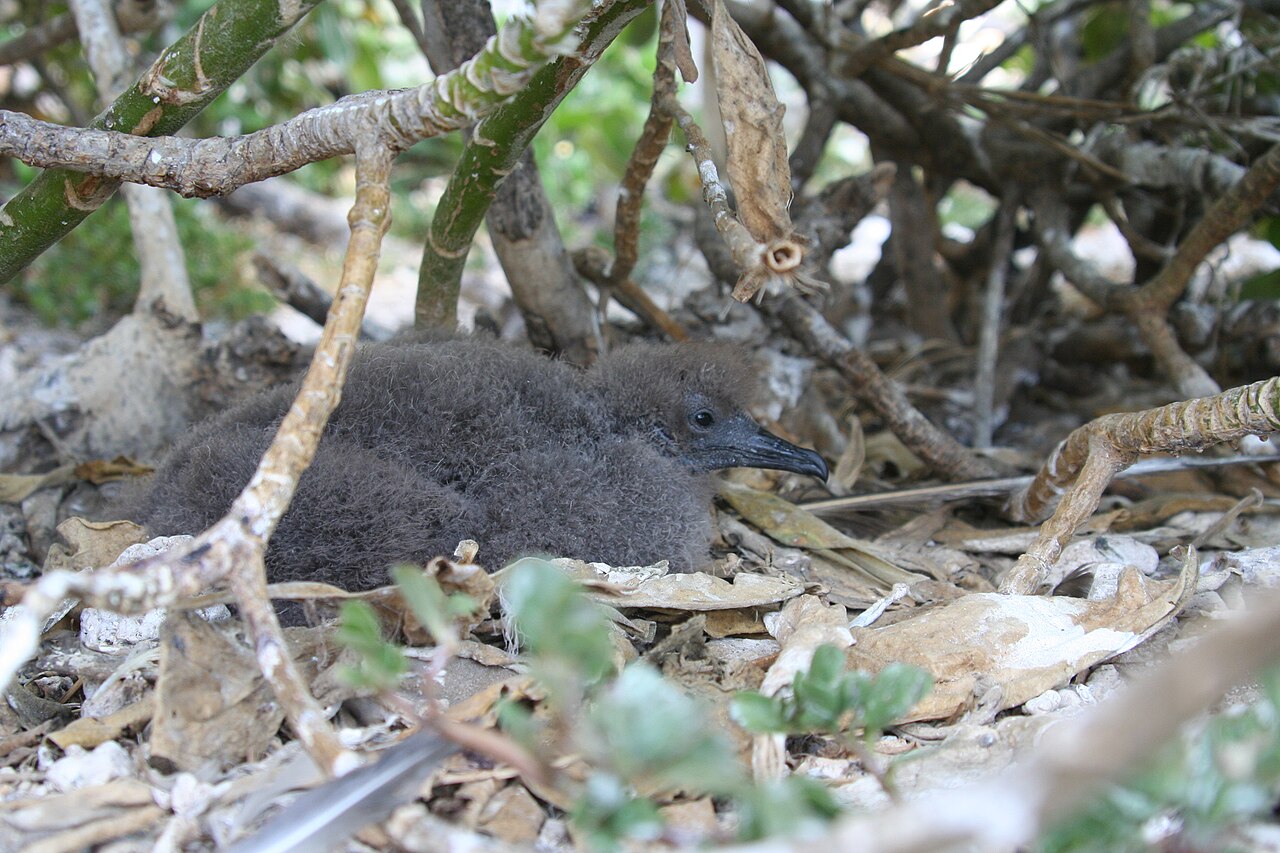
Nestling in the Northwestern Hawaiian Islands
Temperament
colonial but secretive at breeding sites
Flight Pattern
short rapid wingbeats with low glides over wave troughs
Social Behavior
Breeds in loose colonies on remote islands, usually nesting in burrows, crevices, or under vegetation. Pairs are largely monogamous, sharing incubation and chick-rearing duties. Colony attendance is primarily nocturnal, and adults are sensitive to artificial light near breeding areas.
Migratory Pattern
Resident
Song Description
Mostly silent at sea, but at colonies gives eerie moans, wails, and chattering calls at night. Vocalizations carry over the colony and help mates and neighbors recognize one another.
Plumage
Mostly uniform sooty-brown with slightly paler brown underparts and subtly lighter underwing coverts; feathers appear matte with minimal gloss.
Diet
Feeds on small fish, squid, and crustaceans captured near the surface. Often takes prey flushed to the surface by predatory fish such as tunas, and may gather where marine mammals or schools of fish create feeding opportunities. Foraging includes surface-seizing, shallow plunges, and short pursuit dives, typically to modest depths.
Preferred Environment
Warm pelagic waters far offshore, especially along current lines, fronts, and areas with schooling fish. Rarely approaches coastlines except when commuting to and from colonies.


