

The Christmas frigatebird or Christmas Island frigatebird is a seabird of the frigatebird family Fregatidae which is an endemic breeder to Christmas Island in the Indian Ocean. Apart from the Ascension frigatebird, the three other species of frigatebird have much more widely distributed breeding locations.
Region
Eastern Indian Ocean
Typical Environment
Breeds in tall tropical rainforest and coastal trees on Christmas Island, nesting on branches high above the ground. Away from the colony it ranges widely over tropical pelagic waters of the eastern Indian Ocean and adjacent seas, often far from land. Frequently forages along convergence zones and around schools of predatory fish that drive prey to the surface. Roosts in trees or on cliffs near the coast when close to the island.
Altitude Range
Sea level to 360 m
Climate Zone
Tropical
Ease of Keeping
Beginner friendly: 1/5
The Christmas frigatebird breeds only on Australia’s Christmas Island, making it one of the most range-restricted seabirds in the world. Males display by inflating a vivid red throat pouch to attract females. Parents raise a single chick with exceptionally long care, often extending for over a year. Its tiny breeding range makes it highly vulnerable to habitat disturbance, invasive species, and bycatch.

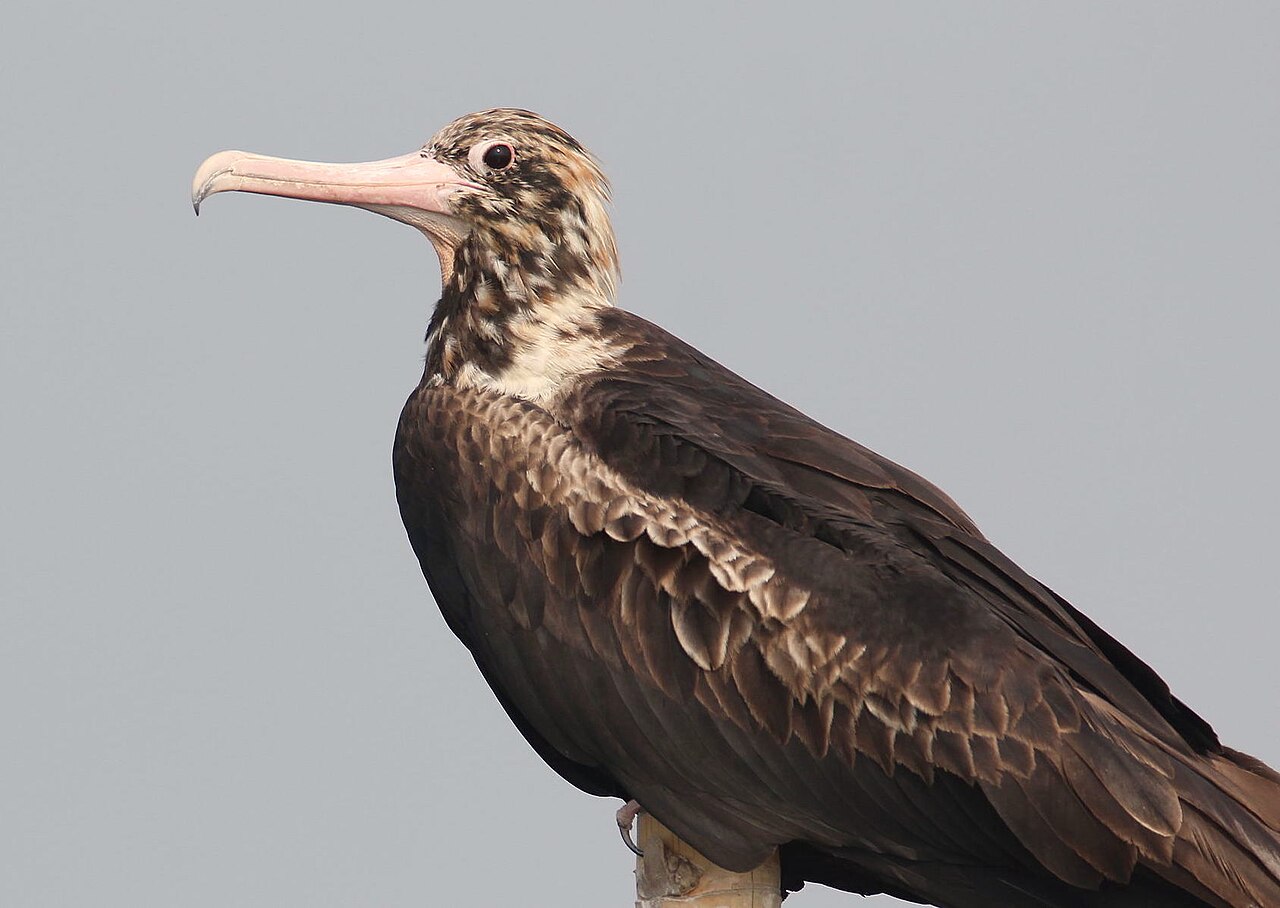
A juvenile at Jakarta Bay, Indonesia
Temperament
social and active
Flight Pattern
soaring glider
Social Behavior
Breeds colonially in trees, with pairs constructing flimsy stick nests. Usually lays a single egg; both parents incubate and feed the chick for many months, with fledglings remaining dependent long after leaving the nest. Displays include aerial chases and male pouch inflation accompanied by calls.
Migratory Pattern
Partial migrant
Song Description
Generally quiet at sea, but at colonies emits rattles, grunts, and drumming sounds associated with display. Males produce percussive noises when vibrating the inflated throat pouch, along with soft clucking calls.
Plumage
Adult males are glossy black with a metallic sheen; females have black upperparts with extensive white underparts separated by a dark breast band. Juveniles show white heads and underparts with darker wings and mantle. Feathers are sleek and wind-cutting, suited to dynamic soaring.
Diet
Takes flying fish and squid captured from the surface, often snatching prey flushed by tuna and other predatory fish. Frequently practices kleptoparasitism, harrying boobies and terns to force them to drop or regurgitate food. Rarely plunges; instead, it seizes items in swift surface dips while on the wing.
Preferred Environment
Open tropical oceanic waters, frontal zones, and areas of upwelling where prey concentrates near the surface. Forages near the island’s coastline when conditions are favorable but ranges widely offshore.


