

The Chilean flamingo is a species of large flamingo at a height of 110–130 cm (43–51 in) closely related to the American flamingo and the greater flamingo, with which it was previously considered a subspecies before being classified as its own species as a result of their lighter color, smaller size and behavioral differences. The species is listed as Near Threatened on the IUCN Red List.
Region
Southern South America
Typical Environment
Found from central Peru and Bolivia through Chile and Argentina to Uruguay, Paraguay, and southern Brazil. It frequents shallow saline and brackish lakes, coastal lagoons, estuaries, and mudflats. Large colonies form on expansive salt pans and hypersaline lakes where food is abundant. Outside the breeding season, birds disperse widely, sometimes moving to lower-altitude wetlands and coastal areas. They may also use man-made saline ponds.
Altitude Range
Sea level to 4500 m
Climate Zone
Temperate
Ease of Keeping
Beginner friendly: 1/5
Chilean flamingos are highly social birds that gather in colonies ranging from hundreds to tens of thousands, nesting on cone-shaped mud mounds. Their pink coloration comes from carotenoids in their diet of algae and small crustaceans, filtered using comb-like lamellae in their specialized bills. Parents feed chicks a nutrient-rich secretion known as crop milk. The species is assessed as Near Threatened by the IUCN due to wetland drainage, mining, and disturbance.


Flock flying in Rio Grande do Sul, Brazil

One preening itself
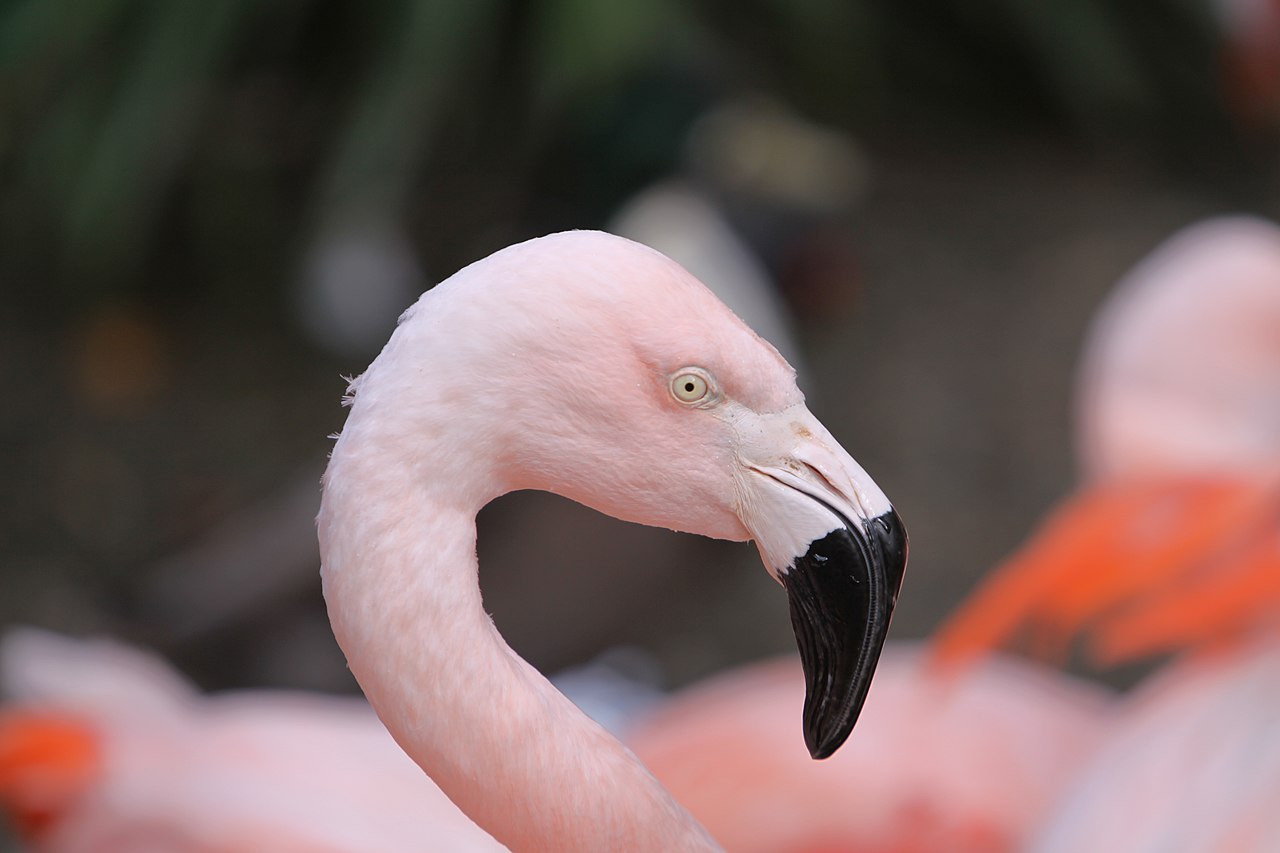
Head of a Chilean flamingo at Durrell Wildlife Park (Jersey)
Temperament
social and gregarious
Flight Pattern
strong flier with steady wingbeats; often flies in lines or V-formations
Social Behavior
Breeds in dense colonies on saline lakes, building tall mud-cone nests that keep eggs above the waterline. Generally monogamous within a season, with both parents incubating a single egg and feeding the chick on crop milk. Flocks coordinate movements while feeding and roosting, and perform synchronized courtship displays.
Migratory Pattern
Partial migrant
Song Description
Vocalizations are loud, nasal honks and gabbling calls reminiscent of geese. In colonies, constant chattering and chorus-like honking help coordinate group movements and maintain social bonds.
Plumage
Pale pink to whitish overall with brighter pink (carmine) wing coverts and black flight feathers.
Diet
Filter-feeds on microscopic algae, diatoms, and blue-green algae, as well as small invertebrates like brine shrimp and other crustaceans. Uses specialized lamellae in the bill to sieve food from the water while the head is held upside down. Often stirs the substrate with its feet to resuspend food particles. Carotenoid-rich prey contributes to its pink coloration.
Preferred Environment
Shallow saline or brackish waters of coastal lagoons, estuaries, and inland salt lakes and pans. Prefers open shorelines and mudflats with minimal emergent vegetation where large groups can feed together.


