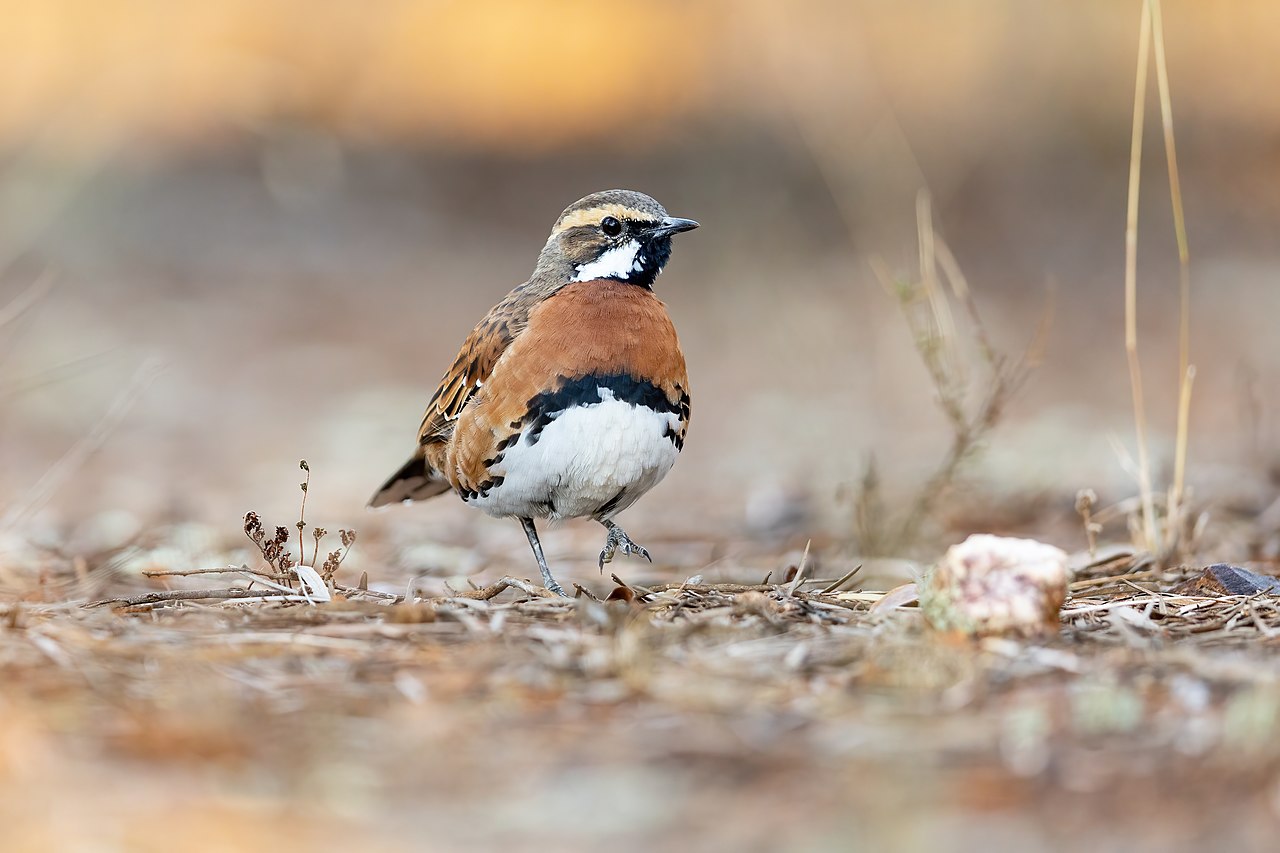
The chestnut-breasted partridge is a partridge species endemic to the eastern Himalayas north of the Brahmaputra, and occurs in Bhutan, Darjeeling, Sikkim, Arunachal Pradesh and south-eastern Tibet at elevations from 350 to 2,500 m. It is listed as near threatened on the IUCN Red List, as the estimated population comprises less than 10,000 individuals. It is threatened by forest degradation and by hunting. It is known from at least three protected areas, including Singalila National Park and Namdapha National Park. The scientific name commemorates the Italian naturalist Louis Mandelli.
Region
Eastern Himalayas
Typical Environment
Occurs north of the Brahmaputra in Bhutan, Darjeeling, Sikkim, Arunachal Pradesh (India), and southeastern Tibet. It inhabits subtropical to temperate broadleaf and mixed montane forests with dense undergrowth, especially bamboo thickets and damp ravines. The species is highly terrestrial and keeps to shaded forest floors and edges, avoiding open country. Populations are patchy where suitable understorey has been logged or degraded.
Altitude Range
350–2500 m
Climate Zone
Highland
Ease of Keeping
Beginner friendly: 2/5
This elusive forest partridge is confined to the eastern Himalayas north of the Brahmaputra, where it forages quietly on the forest floor. It is threatened by habitat degradation and hunting, but persists in protected areas such as Singalila and Namdapha National Parks. Pairs often give clear, whistled duets at dawn and dusk that carry far through the hills. Its scientific name honors the Italian naturalist Louis Mandelli.

Temperament
shy and secretive
Flight Pattern
short rapid wingbeats; explosive flush at close range
Social Behavior
Usually encountered in pairs or small family coveys moving quietly through leaf litter. Nests on the ground, often concealed under dense vegetation. Breeding is presumed to coincide with pre-monsoon to monsoon rains; clutches are small to moderate for a galliform.
Migratory Pattern
Resident
Song Description
Gives clear, far-carrying whistled notes, often delivered as duets at dawn and dusk. Phrases are repeated in accelerating series and used for territorial advertisement.
Plumage
Compact, ground-dwelling partridge with a bold chestnut band across the upper breast, greyish face and neck, and finely scaled black-and-buff underparts. Upperparts are brown with darker mottling; flanks show rufous tones with dark barring.
Diet
Forages by scratching in leaf litter for seeds, fallen fruits, tender shoots, and a variety of invertebrates. Insects, beetles, ants, termites, and small snails are commonly taken, along with occasional earthworms and grubs. May opportunistically pick grains near forest edges.
Preferred Environment
Feeds on the shaded forest floor of dense broadleaf woodland, bamboo brakes, and along stream gullies and trails. Prefers areas with thick understorey cover for protection.