

The cheer pheasant, also known as Wallich's pheasant or chir pheasant, is a vulnerable species of the pheasant family, Phasianidae. It is the only member in the genus Catreus. The scientific name commemorates Danish botanist Nathaniel Wallich.
Region
Western and Central Himalayas
Typical Environment
Occurs in the western and central Himalayas of Pakistan, north India, and Nepal, mainly on steep, grassy slopes interspersed with scrub and rocky outcrops. It favors successional grasslands maintained by seasonal burning and grazing, as well as open pine and oak edges and shrubby ravines. Birds often use ridgelines and terraces near remote villages where cover and forage are available. They typically keep to dense grass during the day, venturing into more open patches to feed in low light. Winter sees local downslope movements to slightly lower, less snowbound aspects.
Altitude Range
1,500–3,500 m
Climate Zone
Highland
Ease of Keeping
Beginner friendly: 2/5
Also called Wallich’s pheasant, the cheer pheasant is the sole member of the genus Catreus and is named in honor of Danish botanist Nathaniel Wallich. It favors steep Himalayan grasslands shaped by traditional grazing and controlled burning, making it sensitive to land-use change. The species is globally Vulnerable due to habitat loss, fragmentation, and hunting pressure. Its loud, far-carrying 'cheer-cheer' duet at dawn and dusk often betrays its presence on otherwise quiet slopes.


Cheer pheasant (male) at Pangot, Nainital, Uttarakhand, India

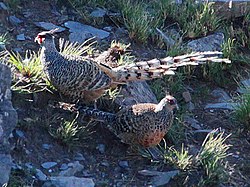
Pair of cheer pheasants near winter Lata village on the periphery of Nanda Devi National Park

Temperament
shy and wary
Flight Pattern
short rapid wingbeats with brief glides
Social Behavior
Typically forms small coveys outside the breeding season and breaks into pairs during breeding. Nests are shallow ground scrapes well concealed in tall grass on steep slopes. Adults lead chicks to forage soon after hatching and rely on nearby cover when disturbed.
Migratory Pattern
Resident
Song Description
A loud, ringing 'cheer-cheer' or 'chir-chir' often delivered in duets by pairs, most frequent at dawn and dusk. Calls carry long distances across valleys and are used for territory advertisement and contact.
Plumage
Overall pale buffy-grey to sandy plumage with fine black barring and vermiculations; long, graduated, pale-barred tail. Male shows a small crest and more contrasting barring; female is slightly smaller and duller with subtler markings.
Diet
Feeds on a mix of plant matter and invertebrates, including seeds, green shoots, berries, roots, and tubers. It scratches and digs in soft soil and litter for bulbs and fallen grain near fields. Insects such as beetles, termites, and grasshoppers are taken especially during chick-rearing. Seasonal availability of grass seeds and agricultural spillage can be important.
Preferred Environment
Forages along grassy slopes, scrubby edges, and lightly grazed terraces where cover meets open patches. Often works ecotones near rocks or shrubs that provide quick refuge from predators.


