

The chattering lory is a forest-dwelling parrot endemic to North Maluku, Indonesia. It is considered vulnerable, the main threat being from trapping for the cage-bird trade.
Region
Maluku Islands (North Maluku), Wallacea
Typical Environment
Occurs in lowland and hill evergreen rainforest, forest edges, and mature secondary growth. It forages mainly in the upper and mid canopy, visiting flowering and fruiting trees. It may enter plantations and village gardens where suitable nectar sources exist. The species tolerates some habitat disturbance but depends on intact forest patches for nesting and regular feeding.
Altitude Range
Sea level to 1200 m
Climate Zone
Tropical
Ease of Keeping
Beginner friendly: 2/5
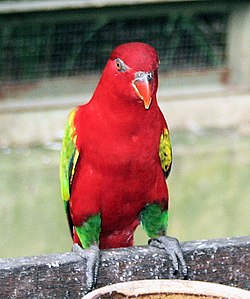
The chattering lory is a vivid red-and-green parrot with a brush-tipped tongue specialized for nectar and pollen. It is heavily trapped for the cage-bird trade, which has driven significant declines despite occurring on several islands. Birds are intelligent, noisy, and highly social, often moving in small flocks through the canopy.



Temperament
social and active
Flight Pattern
short rapid wingbeats with swift, direct flight
Social Behavior
Usually found in pairs or small, noisy groups that move through the canopy in search of flowering trees. Nests in tree cavities, with pairs defending nest sites but feeding communally with nearby birds. Courtship includes mutual preening and calling.
Migratory Pattern
Resident
Song Description
Vocalizations are loud, piercing chatters and screeches delivered in rapid bursts. Contact calls carry over long distances in forest, with excited chattering at feeding trees.
Plumage
Mostly bright red with glossy green wings; some birds show a small violet-blue belly patch and bluish on the flight feathers. Certain subspecies exhibit a yellow patch on the upper back.
Diet
Feeds primarily on nectar and pollen using a brush-tipped tongue. Also takes soft fruits such as figs and berries, and occasionally small insects or larvae for protein. Frequently visits flowering canopy trees and sometimes cultivated blossoms.
Preferred Environment
Forages high in the canopy, especially at flowering and fruiting trees. Will also visit forest edges, gardens, and plantations when blossoms are abundant.


