
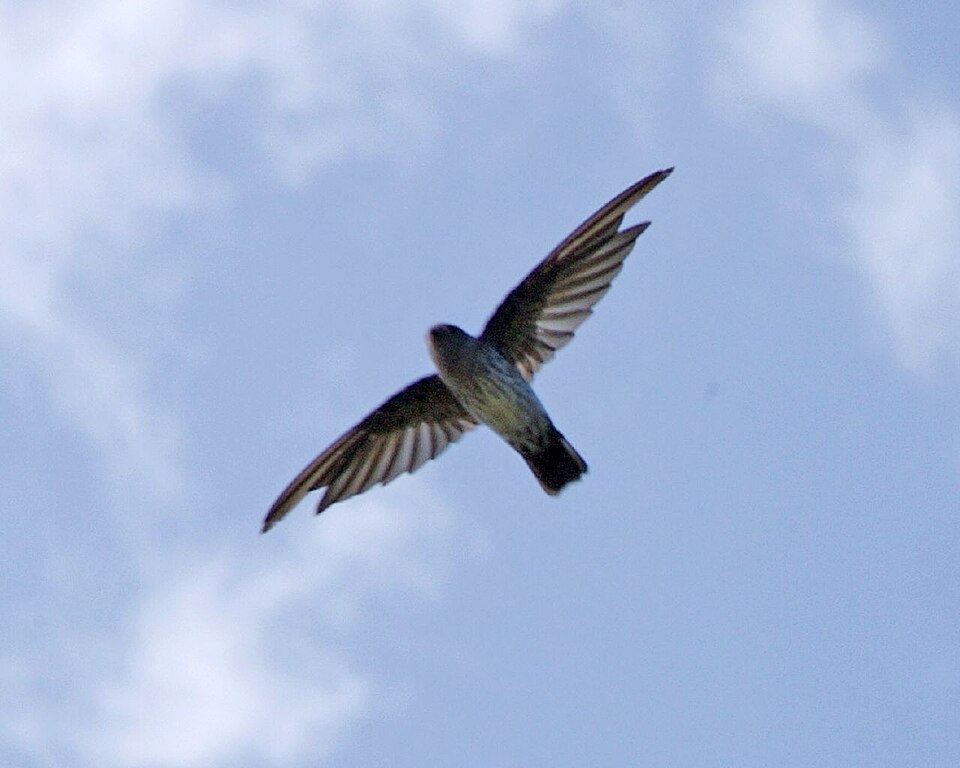
The cave swiftlet or linchi swiftlet is a species of swift in the family Apodidae. It is found on the Indonesia islands of Sumatra, Java and Bali. It is a woodland species and nests in caves. The Bornean swiftlet was considered a subspecies, but is now usually considered distinct.
Region
Sunda Islands (Indonesia)
Typical Environment
Occurs on the Indonesian islands of Sumatra, Java and Bali, where it favors wooded landscapes with nearby limestone or volcanic cave systems. It forages widely over forest edges, clearings, plantations and villages, often far from the nesting cave. Nesting colonies occupy cave ceilings and walls, sometimes deep inside. It readily uses karst landscapes and will hunt above rivers and agricultural fields, especially rice paddies.
Altitude Range
Sea level to 2200 m
Climate Zone
Tropical
Ease of Keeping
Beginner friendly: 1/5
The cave swiftlet, also called the linchi swiftlet, is a small Aerodramus swiftlet that nests in caves across parts of Indonesia. Like several swiftlets, it uses simple clicking sounds to echolocate inside dark cave systems. Its nests are attached to cave walls and made of saliva mixed with plant fibers, unlike the pure saliva nests of the edible-nest swiftlet. The Bornean swiftlet was once treated as a subspecies but is now typically regarded as a separate species.

Temperament
social and active
Flight Pattern
short rapid wingbeats with swift glides
Social Behavior
Forms loose foraging flocks and nests colonially on cave walls and ceilings. Pairs are monogamous during the breeding season, with both parents incubating and feeding the young. Nests are cup-shaped and glued to the substrate with saliva mixed with vegetable fibers.
Migratory Pattern
Resident
Song Description
In open air it gives thin, high twittering and rapid chitters while foraging. Inside caves it produces dry clicking notes used for simple echolocation to navigate in darkness.
Plumage
Small, dusky swiftlet with dark brown upperparts and smoky brown underparts, sometimes with faint pale scaling on the throat. Rump not strongly contrasting; tail shallowly notched. Wings are long and narrow, giving a scythe-like appearance in flight.
Diet
Feeds on small aerial insects such as flies, ants, termites and beetles, captured on the wing. It hawks insects at various heights, adjusting to swarms and wind conditions. During breeding, adults make frequent foraging trips between the cave and nearby feeding grounds. It may concentrate where emergences of termites or other insects are abundant.
Preferred Environment
Commonly forages above forest edges, river corridors, plantations and open farmland, including rice fields. Also circles around cave entrances at dawn and dusk, taking advantage of insect concentrations.


