

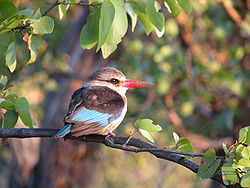
The brown-hooded kingfisher is a species of bird in the subfamily Halcyoninae, the tree kingfishers. It has a brown head and blackish and turquoise wings. It is found in Sub-Saharan Africa, living in woodland, scrubland, forest edges, and also suburban areas. The International Union for Conservation of Nature (IUCN) has assessed it as being of least concern.
Region
Sub-Saharan Africa
Typical Environment
Occurs widely from southern to eastern and parts of central Africa in woodland, savanna, thickets, forest edges, riparian vegetation, and suburban gardens. It prefers areas with scattered trees and open understory for unobstructed perching. Unlike many kingfishers, it does not require large bodies of water and is often found away from rivers and lakes. It avoids dense closed-canopy forests and extremely arid open deserts. In peri-urban environments it uses utility lines, fences, and garden trees as hunting perches.
Altitude Range
Sea level to 2000 m
Climate Zone
Tropical
Ease of Keeping
Beginner friendly: 1/5
Despite being a kingfisher, it rarely fishes; most of its prey is caught on land. It often perches quietly before pouncing on insects, lizards, or small amphibians. The species adapts well to human-modified landscapes and is frequently seen in gardens and suburban areas near trees.


Temperament
solitary and territorial
Flight Pattern
short rapid wingbeats with direct, low flights between perches
Social Behavior
Usually seen alone or in pairs, maintaining territories year-round. Nests are typically excavated in arboreal termite mounds or occasionally in earthen banks. Both sexes share in nest excavation and care for the young.
Migratory Pattern
Resident
Song Description
Voice is a loud, ringing series of clear, piping notes that accelerate or rise in pitch, often delivered from a prominent perch. Also gives sharp chatters and rattles during territorial exchanges.
Plumage
Capped with a warm brown hood contrasting with a whitish throat and pale underparts, with dark upperparts and bright turquoise-blue patches in the wings and tail. Feathers are smooth and sleek, giving a clean, crisp outline on perched birds.
Diet
Feeds mainly on large insects such as beetles, grasshoppers, and caterpillars, supplemented by spiders and other arthropods. It also takes small lizards, frogs, and occasionally small rodents or nestling birds. Prey is usually seized in a swift pounce from a perch and beaten before swallowing. It rarely takes fish compared to river kingfishers.
Preferred Environment
Hunts from exposed perches along woodland edges, clearings, gardens, and lightly wooded savanna. Often uses fences, wires, and low branches to scan open ground or leaf litter for prey.


