The brown-crowned scimitar babbler is a species of bird in the family Timaliidae. It is found in Bhutan, India, Myanmar, Thailand, Laos, Vietnam, and China. Its natural habitat is subtropical moist montane forest.
Region
Eastern Himalayas and mainland Southeast Asia
Typical Environment
Inhabits subtropical and tropical moist montane forests with dense undergrowth, bamboo thickets, and tangled shrubs. Favors steep, shaded slopes, ravines, and forest edges where leaf litter accumulates. Often occurs in secondary growth and degraded forest provided dense cover is present. It is patchily distributed within suitable habitat, frequently near streams and gullies. Typically keeps close to the ground or low in the understory.
Altitude Range
300–2600 m
Climate Zone
Subtropical
Ease of Keeping
Beginner friendly: 1/5
This scimitar babbler is a secretive understory specialist, named for its long, decurved bill used to probe leaf litter and moss for prey. It often travels in pairs or small family groups and readily joins mixed-species flocks. Its ringing, whistled duets carry far through montane forests, making it easier to detect than to see. The species has a broad range across the eastern Himalayas and Southeast Asia and is generally considered of least conservation concern.

Temperament
secretive and skulking
Flight Pattern
short rapid wingbeats
Social Behavior
Usually seen in pairs or small family parties moving through dense understory. Frequently joins mixed-species flocks, especially outside the breeding season. Nests low in thick vegetation; the nest is typically domed or well-concealed. Pairs maintain territories and engage in antiphonal duets.
Migratory Pattern
Resident
Song Description
Song consists of clear, ringing whistles often delivered as coordinated duets between mates. Calls include sharp, scolding notes and rapid chatter when alarmed. The vocalizations carry well through dense foliage.
Plumage
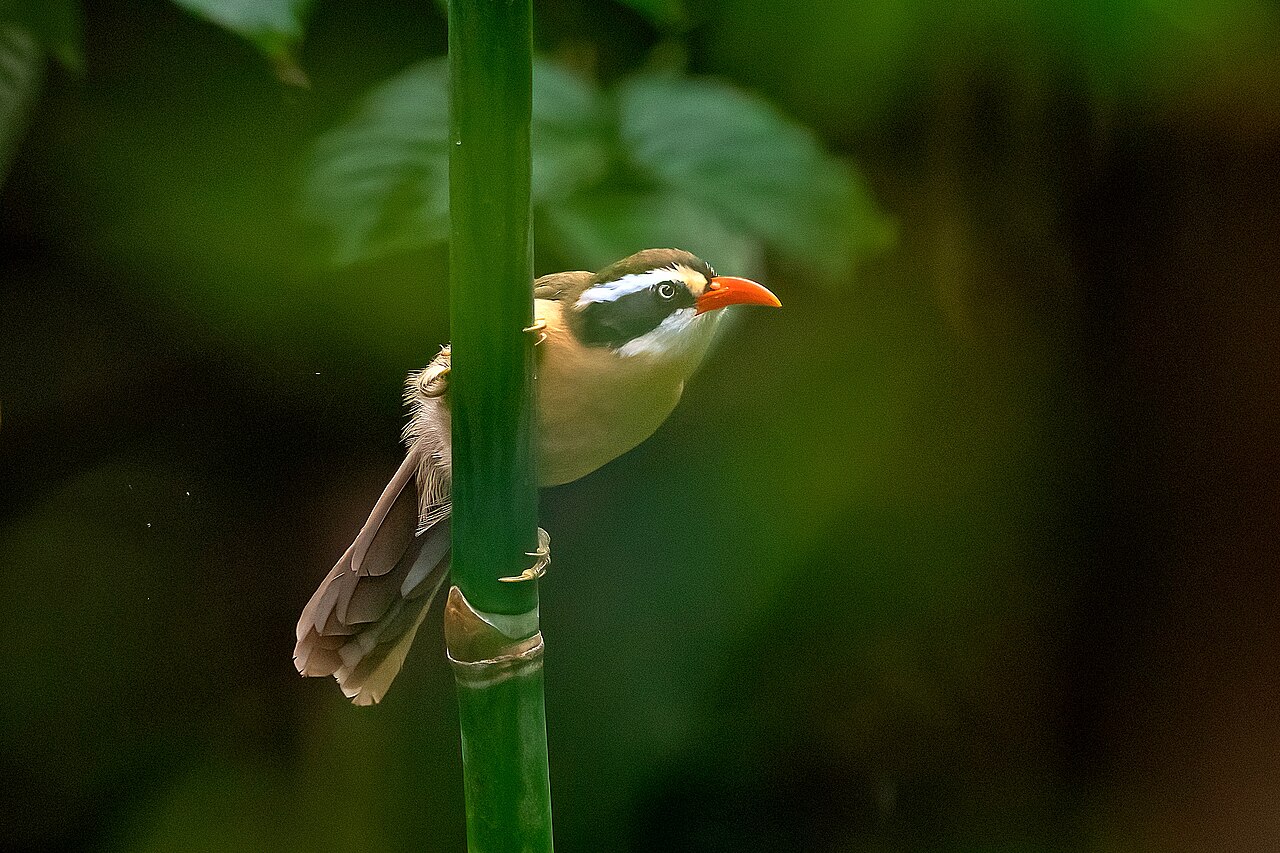
Warm brown upperparts with a rich rufous-brown crown and nape, contrasting with a clean white throat and breast that may show faint buffy wash. Prominent white supercilium set above a dark eye-stripe gives a masked look. Underparts are buff to olive-buff with slightly warmer flanks; wings and tail brown. The long, decurved bill is a key feature.
Diet
Primarily feeds on insects and other small invertebrates such as beetles, ants, termites, caterpillars, and spiders. Uses its long bill to probe leaf litter, mossy trunks, and bark crevices. Occasionally takes small snails and will supplement with berries or small fruits when available.
Preferred Environment
Forages close to the ground in dense understory, bamboo, and vine tangles. Often works along forest edges, streamside thickets, and ravines where moist leaf litter is abundant. Will utilize secondary growth if cover is sufficient.