

The bridled tern is a seabird of the family Laridae. It is a bird of the tropical oceans. The scientific name is from Ancient Greek. The genus comes from onux meaning "claw" or "nail", and prion, meaning "saw". The specific anaethetus means "senseless, stupid".
Region
Tropical Atlantic, Indian and Pacific Oceans
Typical Environment
Breeds on remote tropical and subtropical islands, coral cays, and rocky islets. Forages over warm pelagic waters and along oceanic fronts, often near reefs and continental shelves. Frequently associates with drift lines and sargassum mats where prey concentrates. Outside the breeding season it disperses broadly across the open ocean and rarely approaches mainland coasts.
Altitude Range
Sea level to 300 m
Climate Zone
Tropical
Ease of Keeping
Beginner friendly: 1/5
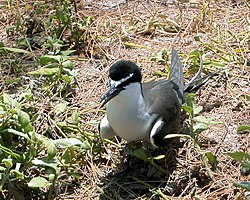
Named for the white 'bridle' formed by its supercilium and nape, the bridled tern is a sleek tropical seabird that spends most of its life far offshore. It nests in shaded crevices or under low vegetation to protect its single egg from heat. Outside the breeding season it disperses widely over warm oceans and may roost on flotsam or buoys. It is often seen with sooty terns but is browner above and more contrastingly marked on the head.


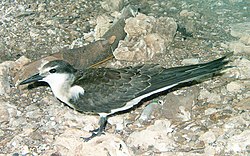
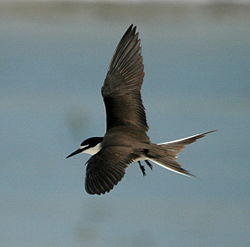
Onychoprion anaethetus - MHNT



Temperament
social and active
Flight Pattern
buoyant with quick wingbeats and short glides
Social Behavior
Breeds colonially on islands, often in loose to dense groups. Nests are typically in crevices, under rocks, or beneath low shrubs; the clutch is usually a single egg with both parents incubating and feeding the chick. Outside breeding, birds form rafts at sea and roost on flotsam, buoys, or isolated rocks.
Migratory Pattern
Partial migrant
Song Description
Calls are sharp and nasal, with kip and kirrick notes in flight. At colonies, a repetitive churring and kik-kik series carries over surf and wind.
Plumage
Slender tern with chocolate-brown upperparts, white underparts and forehead, and a blackish crown and nape offset by a narrow white supercilium forming a 'bridle'. Upperwings are brown with darker primaries; underwings are pale with dusky edges. Tail is long and deeply forked.
Diet
Feeds mainly on small schooling fish and squid taken near the surface. Often forages alongside predatory fish or dolphins that drive prey upward. Captures food by surface-dipping and shallow plunge-dives and will snatch items from slicks and drift lines. Also takes small crustaceans from sargassum mats.
Preferred Environment
Forages over warm offshore waters near islands, reefs, and oceanic fronts. Common along lines of floating seaweed and convergences where prey aggregates. Rarely feeds close to shore except near colonies.


