

The brahminy starling or brahminy myna is a member of the starling family of birds. It is usually seen in pairs or small flocks in open habitats on the plains of the Indian subcontinent.
Region
Indian Subcontinent
Typical Environment
Found widely across the plains and open country of the Indian subcontinent, including agricultural landscapes, scrub, dry deciduous edges, parks, and gardens. It is especially common near human habitation and in semi-urban settings. The species avoids dense forest and high alpine zones, favoring scattered trees and open habitats. It readily exploits man-made structures for nesting when natural cavities are scarce.
Altitude Range
0–1500 m
Climate Zone
Tropical
Ease of Keeping
Beginner friendly: 2/5
Also called the brahminy myna, this starling often frequents towns, villages, and temple grounds—its Latin name refers to pagodas. It frequently nests in cavities in trees and buildings and readily uses nest boxes. The species is highly adaptable, feeding on insects, fruits, and flower nectar, and often forages in small, sociable groups.


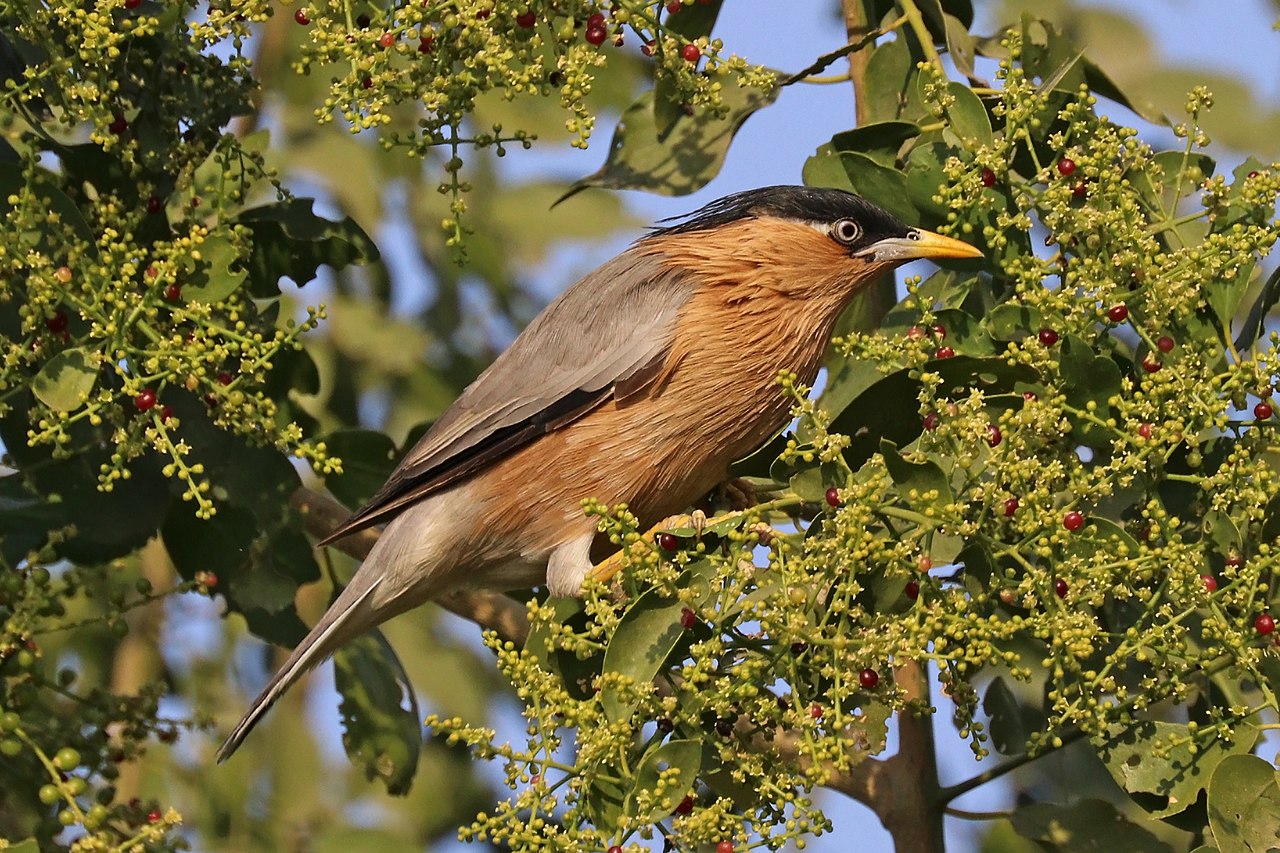
A young bird with the base of the mandible grey, Rajasthan
Temperament
social and active
Flight Pattern
strong and direct with short rapid wingbeats
Social Behavior
Often seen in pairs during the breeding season and in small flocks otherwise, forming large communal roosts in reeds or trees. Nests in cavities in trees, walls, or buildings, sometimes reusing old woodpecker or barbet holes. Both sexes participate in nest building and care for the young.
Migratory Pattern
Resident
Song Description
A varied, soft warbling song interspersed with nasal mews and chattering notes. Calls are mellow yet carry well, and the species can incorporate mimicry-like phrases.
Plumage
Smooth, sleek plumage with warm buff-cinnamon underparts, grayish mantle and wings, and a glossy black cap forming a small shaggy crest.
Diet
Consumes a wide range of insects (beetles, termites, caterpillars), fruits, berries, and flower nectar. It often probes blossoms of trees such as coral trees and silk cotton for nectar. During breeding, insect prey becomes more prominent; outside the season, fruits and nectar can form a substantial part of the diet.
Preferred Environment
Forages on the ground in open fields and along roadsides, as well as in flowering trees and shrubs in parks and gardens. Frequently feeds near human habitation and agricultural plots where insects and fallen fruits are abundant.


