

The brambling is a small passerine bird in the finch family Fringillidae. It has also been called the cock o' the north and the mountain finch. It is widespread and migratory, often seen in very large flocks.
Region
Northern Eurasia
Typical Environment
Breeds across the boreal and subarctic forests from Scandinavia through northern Russia to eastern Siberia. In winter it disperses widely into western, central, and southern Europe, the Mediterranean, North Africa, the Middle East, northern India, and East Asia including China and Japan. Prefers coniferous and mixed birch–spruce woods for breeding, shifting to beech woods, farmland, parks, and gardens in the nonbreeding season. Often concentrates locally where beech mast or other seed resources are abundant.
Altitude Range
Sea level to 2000 m
Climate Zone
Temperate
Ease of Keeping
Beginner friendly: 2/5
Bramblings are gregarious finches that can form enormous winter flocks numbering in the hundreds of thousands when beech mast crops are abundant. Males develop a striking black head in breeding plumage, while both sexes show a distinctive white rump in flight. They often irrupt southward in exceptional numbers following poor food years in the north. They readily visit feeders in winter, especially where sunflower seeds are offered.


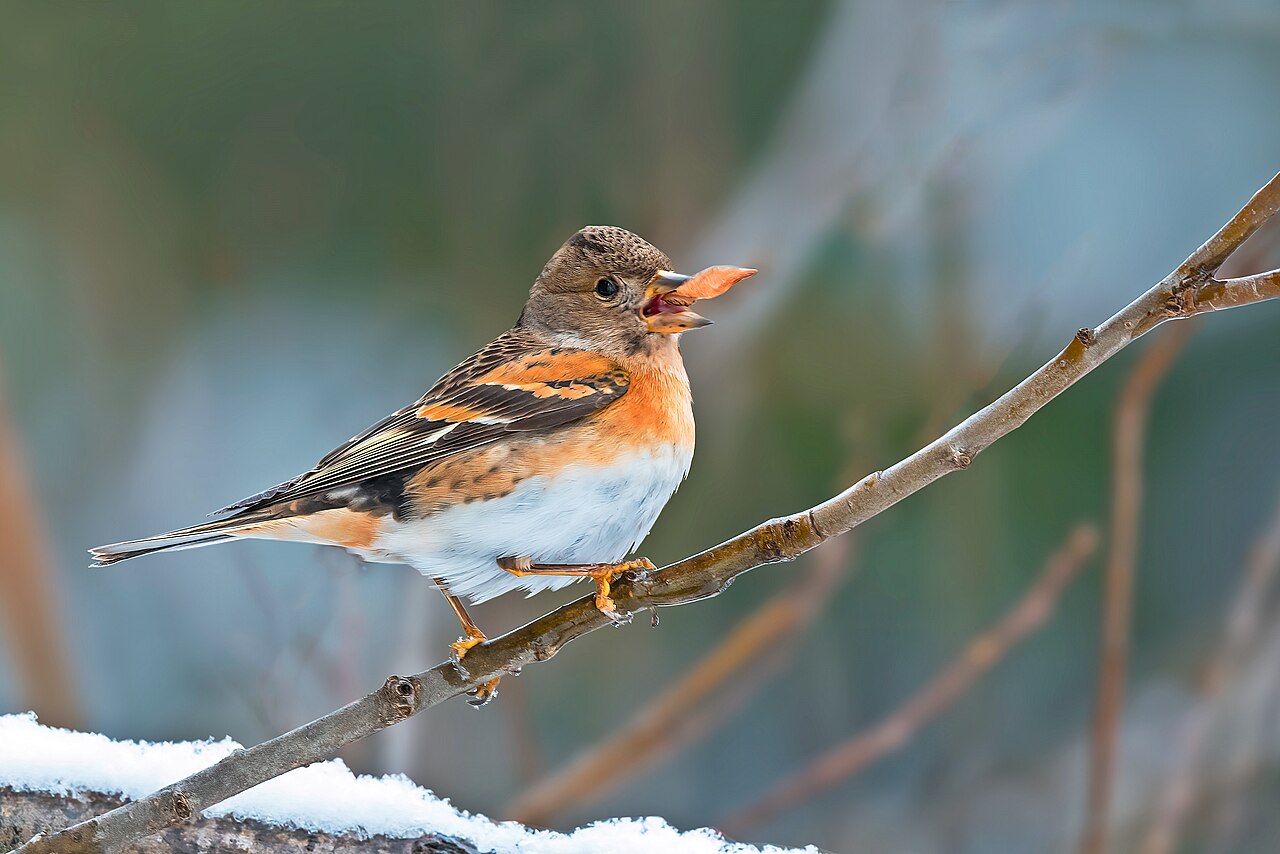
Brambling in Pahalgam, Anantnag, Jammu and Kashmir

Male and female in Poland

Eggs, Muséum de Toulouse
Temperament
social and active
Flight Pattern
bounding flight with short, rapid wingbeats
Social Behavior
Highly gregarious outside the breeding season, forming large flocks that feed and roost communally. Breeds in loose pairs or small groups in boreal woodland, building a cup nest in trees or tall shrubs. Typically monogamous within a season, with both parents feeding the young.
Migratory Pattern
Seasonal migrant
Song Description
Song is a simple, nasal, buzzing series often described as a repeated wheezy phrase. Calls include a sharp, nasal 'zwee' or 'dweee' given in flight and within flocks.
Plumage
Crisp, patterned plumage with orange breast and shoulders, white belly and rump, and dark upperparts; males acquire a glossy black head in breeding season that appears mottled in winter. Wings show pale bars and contrasting patches, and the rump is conspicuously white in flight.
Diet
In winter it feeds mainly on seeds, especially beech mast, as well as weed seeds and grain; it will visit garden feeders for sunflower seeds. During the breeding season it switches to insects—particularly caterpillars, beetles, and other arthropods—to feed growing chicks. It may also take berries when available.
Preferred Environment
Forages on the ground under trees, in stubble fields, and at woodland edges in winter, often in dense flocks. In summer it searches foliage and the forest floor within coniferous and mixed woods.


