
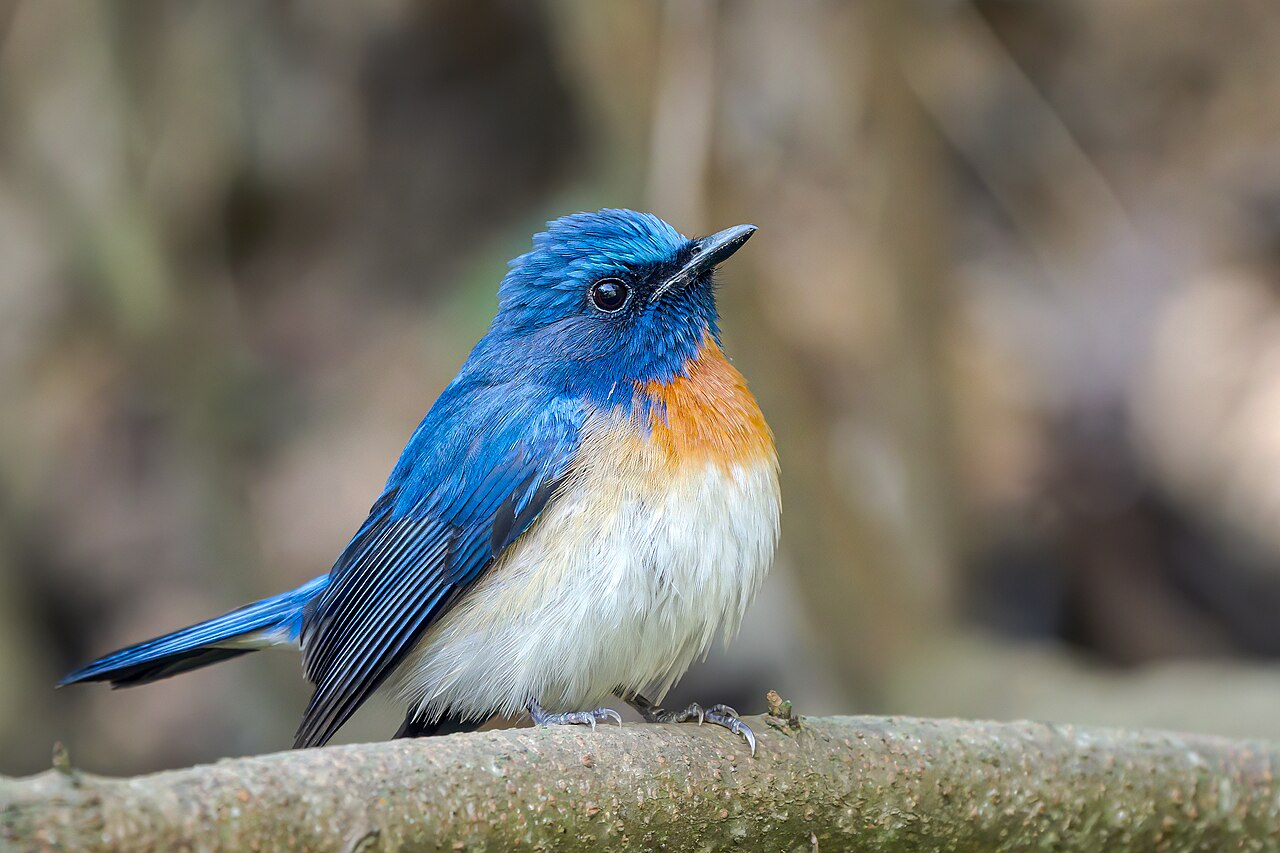
The blue-throated blue flycatcher is a small passerine bird in the flycatcher family, Muscicapidae. It resembles Cyornis tickelliae but easily separated by the blue throat. The habitat of this species is a thicker forest than other species of flycatchers. The blue-throated flycatcher is found in much of the Indian Subcontinent, all through the Himalayas, the plains and Western Ghats of India in the cold months, and also extends eastwards into Bangladesh, and to Arakan and the Tenasserim Hills in Myanmar.
Region
Indian Subcontinent and Southeast Asia
Typical Environment
Prefers dense, moist forest with a well-developed understory, including evergreen and semi-evergreen tracts and shaded ravines. It frequents bamboo thickets, forest edges, and streamside vegetation where cover is thick. During the breeding season it occupies mid-elevation Himalayan foothill forests; in winter it spreads into the plains, Western Ghats, and well-wooded areas of Bangladesh and Myanmar. It also uses secondary growth, orchards, and large tree-filled gardens when adequate cover is present.
Altitude Range
Sea level to 2000 m
Climate Zone
Tropical
Ease of Keeping
Beginner friendly: 1/5
Often confused with Tickell's blue flycatcher, but the male’s entirely blue throat and upper breast are diagnostic. It favors denser, shady forest than many other blue flycatchers and often keeps low in the understory. Within South Asia it is a seasonal and altitudinal migrant, descending to the plains and peninsular woodlands in winter.


Temperament
solitary and territorial
Flight Pattern
short rapid wingbeats
Social Behavior
Typically solitary or in pairs during the breeding season, defending small territories from low to mid-level perches. Nest is a neat cup placed in a tree hole, stump, or crevice, lined with fine fibers and moss; clutch size is usually 3–5 eggs. Outside the breeding season it may join mixed-species flocks in the understory.
Migratory Pattern
Seasonal migrant
Song Description
Song is a sweet, mellow series of clear whistles and short phrases delivered from shaded perches, often at dawn. Calls include thin tseep contact notes and sharper scolding chips when disturbed.
Plumage
Male has deep blue upperparts with a bright blue throat and upper breast, contrasting whitish belly and vent; female is brownish-olive above with a faint bluish tail and wings and a pale throat. Both sexes show a fine pale eye-ring and relatively plain underparts.
Diet
Feeds mainly on insects such as flies, beetles, moths, caterpillars, termites, and ants, as well as spiders. Hunts by sallying out from low to mid-level perches to catch aerial prey and by gleaning from foliage and bark. Occasionally takes small berries and other soft fruits, especially in the non-breeding season. Often forages at forest edges and small clearings where insect activity is high.
Preferred Environment
Forages in shaded understory, along streamside vegetation, and at forest edges. In winter it readily uses secondary growth and well-wooded gardens or orchards while keeping close to cover.


