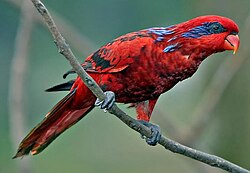
The blue-streaked lory is also known as the blue-necked lory. It is a medium-sized parrot (31 cm), which is found on the Tanimbar Islands and Babar in the southern Moluccas.
Region
Southern Maluku Islands
Typical Environment
Occurs naturally on the Tanimbar Islands and Babar in Indonesia. It inhabits lowland tropical forest, coastal woodland, and mangroves, and readily uses secondary growth and edges. The species also frequents village gardens and coconut or other flowering plantations where nectar is abundant. It is most often encountered in the canopy or flying between patches of trees. Local movements track flowering resources.
Altitude Range
Sea level to 500 m
Climate Zone
Tropical
Ease of Keeping
Beginner friendly: 2/5
Also called the blue-necked lory, this species is notable for the blue streaking across its otherwise red plumage. Like other lories and lorikeets, it has a brush-tipped tongue adapted for feeding on nectar and pollen. It is naturally inquisitive and noisy, often seen commuting between flowering trees. Trapping and habitat change on small islands can affect local numbers.




Temperament
social and active
Flight Pattern
strong flier with rapid wingbeats and direct, swift flight
Social Behavior
Usually seen in pairs or small, noisy groups that travel between flowering trees. They nest in tree cavities and are thought to be largely monogamous. Courtship involves mutual preening and vocal exchanges near nest sites.
Migratory Pattern
Resident
Song Description
Vocalizations are loud, sharp screeches and chatter, often given in flight. At feeding sites they produce rapid, nasal calls and contact notes to maintain group cohesion.
Plumage
Predominantly red with distinctive blue streaking across the neck and upper breast; flight feathers darker with a dusky tone.
Diet
Feeds primarily on nectar and pollen from a variety of flowering trees, using a brush-tipped tongue. Also takes soft fruits such as figs and berries and occasionally consumes seeds or small invertebrates. Its movements often follow seasonal flowering peaks.
Preferred Environment
Forages in the canopy of forest, edge habitats, and mangroves, and commonly visits village trees and plantations. Frequently gathers at mass-flowering trees where multiple individuals feed together.