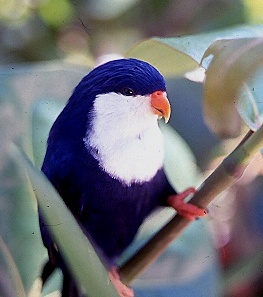
The blue jewel-babbler is a species of bird in the family Cinclosomatidae. It is found in New Guinea. In Wampar, spoken among the people who live in Markham Valley of New Guinea, it is referred to as the birisis. Its natural habitat is subtropical or tropical moist lowland forests—typically primary rather than secondary forests.
Region
New Guinea
Typical Environment
Occurs throughout suitable lowland and foothill rainforest on the island of New Guinea, in both Papua New Guinea and Indonesian New Guinea. It prefers dense, shaded primary forest with thick understory and tangled vine thickets. Birds are most often encountered along quiet forest trails, stream edges, and on the dim forest floor where leaf litter is abundant. It may enter selectively logged areas but is markedly less frequent in heavily disturbed secondary growth.
Altitude Range
Sea level to 1200 m
Climate Zone
Tropical
Ease of Keeping
Beginner friendly: 1/5
A secretive ground-dwelling songbird of New Guinea’s lowland rainforests, the blue jewel-babbler is famed for its vivid cobalt-blue plumage that glows in dim understory light. It forages by hopping and flicking leaf litter, often remaining hidden except for quick dashes across trails. Pairs keep close contact with soft calls and may duet at dawn. It favors primary forest and is less common in degraded habitats.

Temperament
secretive and skulking
Flight Pattern
short rapid wingbeats, low-level dashes between cover
Social Behavior
Usually in pairs or small family groups that keep to dense understory. Nests are placed close to the ground or low in vegetation, and both sexes likely participate in care. Territorial calling is most frequent at dawn and dusk, with pairs maintaining contact via soft notes.
Migratory Pattern
Resident
Song Description
A series of clear, fluty whistles delivered in measured phrases, often with a mellow, bell-like quality. Pairs may duet antiphonally, with notes rising and falling and carrying surprisingly far in still forest.
Plumage
Glossy, jewel-like blue on the face, throat, and underparts with darker, blackish-brown upperparts. Feathers appear velvety in low light, enhancing the contrast between the bright blue and dark mantle. The tail and wings are dusky, and the overall impression is of a compact, blue-fronted bird of the forest floor.
Diet
Primarily small invertebrates taken from the forest floor, including beetles, ants, termites, caterpillars, and spiders. It probes leaf litter, flips leaves, and gleans from low stems and fallen branches. Occasionally it supplements with small berries or seeds, especially when invertebrate activity is low.
Preferred Environment
Feeds on the dim forest floor and in dense understory tangles where cover is close. Often forages along quiet trails and stream margins, retreating quickly to thickets when disturbed.