
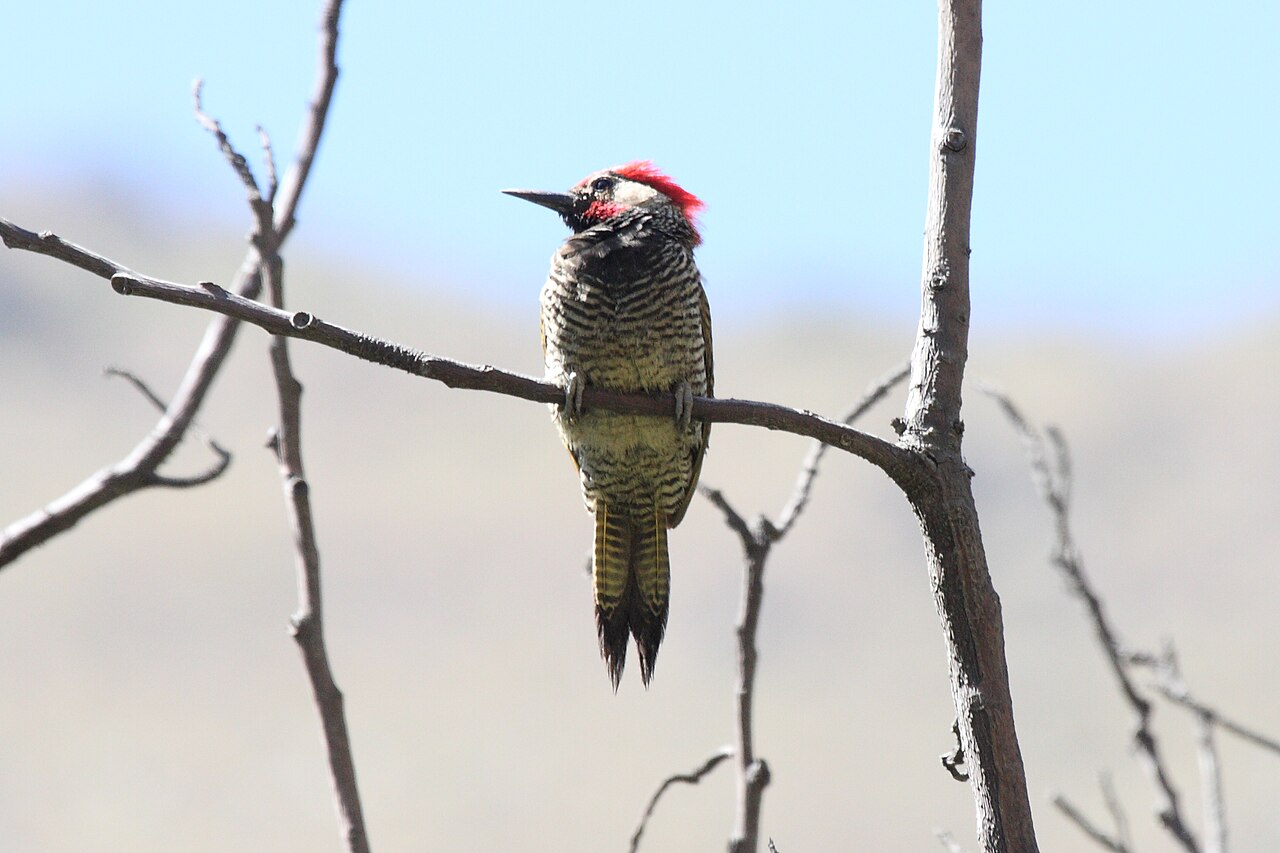
The black-necked woodpecker or black-necked flicker is a species of bird in subfamily Picinae of the woodpecker family Picidae. It is endemic to Peru.
Region
Peruvian Andes and coastal valleys
Typical Environment
Occurs on the west slope of the Andes and in adjacent coastal valleys of Peru, favoring arid to semiarid scrub, cactus-dominated slopes, and dry woodland. It also uses agricultural mosaics and field edges, especially where scattered trees or large cacti provide nesting sites. Often found along dry river washes, rocky hillsides, and open thorn forest with Prosopis. The species tolerates some human-modified landscapes provided there are open foraging areas and suitable cavity sites.
Altitude Range
Sea level to 3000 m
Climate Zone
Arid
Ease of Keeping
Beginner friendly: 1/5
The black-necked woodpecker is a Peruvian endemic flicker adapted to arid scrub and dry intermontane valleys. Unlike many woodpeckers, it often forages on the ground for ants and their larvae. It frequently excavates nest cavities in cacti as well as in soft, dead wood. Its conspicuous white rump and bounding flight make it easy to pick out in open habitats.


Black-necked Woodpecker endemic in Peru

Temperament
wary but active
Flight Pattern
undulating with short rapid wingbeats and brief glides
Social Behavior
Typically seen singly or in pairs during the breeding season, forming territorial pairs that excavate their own nest cavities. Both sexes participate in excavation and incubation. Outside breeding, small loose groups may forage together on open ground. Territorial drumming and vocalizations are used to advertise and defend nesting areas.
Migratory Pattern
Resident
Song Description
Calls are loud, ringing series of clear notes, reminiscent of other flickers, often given from exposed perches. Drumming is strong and resonant, delivered on hollow limbs or cactus trunks. Contact calls include sharp, repeated notes during foraging and pair interactions.
Plumage
Upperparts barred with dark and pale tones; underparts pale with dark spotting and barring. A contrasting black neck and head area gives the species its name, with a clean white rump visible in flight. Feathers are firm and slightly glossy, typical of woodpeckers, with stiff tail feathers used for bracing on vertical surfaces.
Diet
Primarily consumes ants, termites, and their larvae, which it gleans and probes from the ground and from rotten wood or cactus tissue. Also takes beetles and other small invertebrates. Supplements its diet seasonally with fruit and berries, especially in dry seasons when insect activity is lower.
Preferred Environment
Forages in open arid scrub, along field margins, and in dry riverbeds where ant activity is high. Often feeds on the ground, but will also probe cacti and dead wood for larvae. Uses perches such as fence posts, boulders, and cactus arms to scan for foraging spots.


