

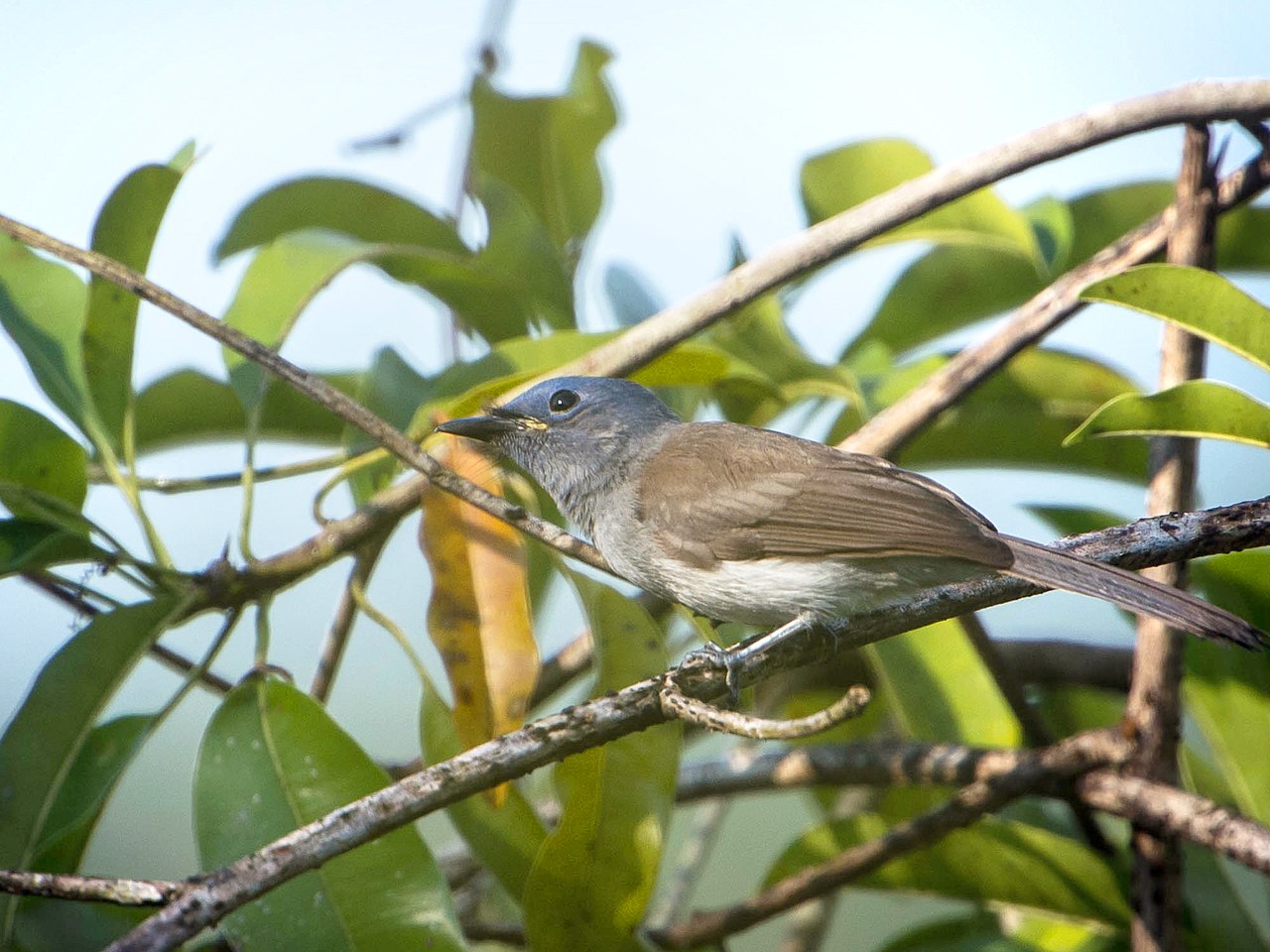
The black-naped monarch or black-naped blue flycatcher is a passerine bird belonging to the family of monarch flycatchers found in southern and south-eastern Asia. They are sexually dimorphic, with the male having a distinctive black patch on the back of the head and a narrow black half collar ("necklace"), while the female is duller with olive brown wings and lacking the black markings on the head. They have a call that is similar to that of the Asian paradise flycatcher, and in tropical forest habitats, pairs may join mixed-species foraging flocks. Populations differ slightly in plumage colour and sizes.
Region
South and Southeast Asia
Typical Environment
Occurs from the Indian subcontinent and Sri Lanka through Myanmar, Thailand, Laos, Cambodia, Vietnam, and southern China to Malaysia, Indonesia, and the Philippines. It inhabits moist broadleaf forests, forest edges, secondary growth, riverine woodland, and well-vegetated gardens near forest. Birds use the understory to mid-canopy, often perching in shaded areas to sally after flying insects. It readily joins mixed-species foraging flocks in tropical forest interiors.
Altitude Range
Sea level to 1800 m
Climate Zone
Tropical
Ease of Keeping
Beginner friendly: 1/5
The black-naped monarch is a lively forest flycatcher of South and Southeast Asia, often accompanying mixed-species flocks as it hunts insects. Males are a striking soft blue with a distinctive black nape patch and narrow half-collar, while females are duller and lack the black markings. The species builds a neat, camouflaged cup nest bound with spider silk and often adorned with lichens. Its clear, liquid whistles can resemble the calls of the Asian paradise flycatcher.


H. a. montana at nest in Thailand

Black-naped monarch feeding its nestlings at Wilpattu national park – Sri Lanka

Male

Female
Temperament
active and inquisitive
Flight Pattern
short rapid wingbeats with frequent sallies from low to mid-level perches
Social Behavior
Typically seen as pairs or family groups and commonly joins mixed-species flocks outside the breeding season. Monogamous pairs build a small cup nest on a forked branch, bound with spider silk and often decorated with lichens for camouflage. Both sexes incubate and feed the young, and they defend a small territory during breeding.
Migratory Pattern
Resident
Song Description
Song is a series of clear, liquid whistles and sweet, piping notes delivered from shaded perches. Calls include sharp chips and soft, musical phrases that can resemble the Asian paradise flycatcher.
Plumage
Male soft azure-blue above with paler bluish-grey below, a glossy black nape patch and a narrow black half-collar; wings and tail slightly darker. Female is greyer-blue to brownish-olive above with duller underparts and lacks the black markings; wings may appear olive-brown. Both sexes show a neat, compact shape with a slight crest that can be raised.
Diet
Feeds primarily on flying insects such as flies, beetles, moths, and small wasps, which it catches by short aerial sallies. It also gleans caterpillars, small bugs, and spiders from foliage and twigs. Foraging is agile and methodical, with frequent returns to a preferred perch.
Preferred Environment
Forages in the shaded understory to mid-canopy of humid forest, edges, and riparian woodland. It often hunts along trails, stream banks, and light gaps where insects are abundant. In human-modified areas, it may work through well-vegetated gardens near forest.


