

The black grouse, also known as northern black grouse, Eurasian black grouse, blackgame or blackcock, is a large bird in the grouse family. It is a sedentary species, spanning across the Palearctic in moorland and steppe habitat when breeding, often near wooded areas. They will spend the winter perched in dense forests, feeding almost exclusively on the needles of conifers. The black grouse is one of two species of grouse in the genus Lyrurus, the other being the lesser-known Caucasian grouse.
Region
Northern and central Europe to western Siberia (Palearctic)
Typical Environment
Breeds in a mosaic of open moorland, heath, peat bogs, and forest edges, often with birch, willow, and scattered conifers. Prefers transitional zones where open ground meets light woodland or scrub. Winters in or near coniferous forests, where it may roost in trees or burrow into snow in colder regions. Avoids dense, closed canopy forests and intensively managed monocultures, favoring structurally diverse habitats.
Altitude Range
0–2200 m
Climate Zone
Temperate
Ease of Keeping
Beginner friendly: 2/5
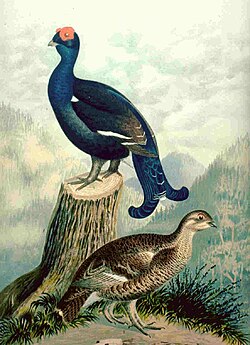
Black grouse are famous for dramatic dawn lekking displays where males fan their lyre-shaped tails, show bold white under-tail patches, and bubble-hiss to attract females. Males are mostly glossy black with a blue sheen and striking white wingbars, while females are mottled brown for camouflage. Populations have declined in parts of western Europe due to habitat loss and fragmentation, but the species remains widespread across the Palearctic.


Egg of Tetrao tetrix tetrix - MHNT

The black grouse in the coat of arms of Tuusniemi



Temperament
wary and secretive, males highly territorial on leks
Flight Pattern
explosive takeoff with short rapid wingbeats followed by glides
Social Behavior
Outside the breeding season they can form small flocks, often segregated by sex. In spring, males gather at traditional leks to display, while females visit briefly to select mates; mating is polygynous. Nests are shallow ground scrapes hidden in heather or grass; females incubate and tend the brood alone.
Migratory Pattern
Partial migrant
Song Description
The lek song is a resonant bubbling coo interspersed with sharp hisses and sneezes. Calls carry over open moorland at dawn and dusk, with increased intensity during peak display days.
Plumage
Males glossy black with a blue sheen, bold white wingbars, and lyre-shaped tail; females finely barred and mottled brown with a shorter, slightly notched tail.
Diet
In winter it feeds largely on buds, catkins, and needles of birch, willow, and conifers. In spring and summer it takes leaves, shoots, heather, berries such as bilberry, and seeds. Chicks rely heavily on insects, especially beetles and caterpillars, to meet protein needs. Grit is ingested to aid digestion of fibrous plant material.
Preferred Environment
Forages along forest edges, in heaths and bogs, and among scrubby birch–willow mosaics. In winter it often feeds in treetops or near sheltering conifers and may use snow burrows for roosting nearby.


