

The black crowned crane is a part of the family Gruidae, along with its sister species, the grey crowned crane. It is topped with its characteristic bristle-feathered golden crown. It is usually found in the shallow wetlands of sub-Saharan Africa during the wet season, which act as its principal breeding, feeding and roosting sites although it can also be found foraging in grasslands and near croplands of dry savanna.
Region
West and Central Africa
Typical Environment
This species inhabits the Sahel and savanna belt from Senegal and Gambia east through Mali, Niger, Chad, and northern Cameroon to South Sudan and Ethiopia, with scattered populations farther south. It is closely tied to shallow wetlands, floodplains, and seasonal pans for breeding, feeding, and roosting. Outside peak flooding, it forages widely in adjacent grasslands, pastures, and croplands. Nests are built in dense emergent vegetation within marshes or along the edges of floodplains. Local movements track rainfall and changing water levels.
Altitude Range
0–1500 m
Climate Zone
Tropical
Ease of Keeping
Beginner friendly: 2/5
The black crowned crane is one of only two crane species that regularly roost in trees, helped by a long hind toe that allows perching. It performs elaborate dances with bows, leaps, and wing-flashing during courtship and social displays. It often follows grazing animals or agricultural activity to catch disturbed insects. Habitat loss and capture for trade are key threats across its range.


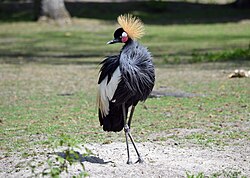
Side profile of Balearica pavonina ceciliae



Temperament
social and wary
Flight Pattern
strong flier with slow, deep wingbeats and short glides
Social Behavior
Outside the breeding season it forms loose flocks and communal roosts, often in trees. Breeding pairs are monogamous and defend territories around wetland nest sites. Nests are platforms of vegetation hidden in dense reeds or sedges, with both sexes participating in incubation and chick rearing.
Migratory Pattern
Resident
Song Description
Vocalizations are loud, honking calls and braying notes, often given in duets by pairs. Calls carry over long distances and accompany display dances with wing-flapping and head-bobbing.
Plumage
Mostly blackish body with contrasting white wing coverts often tinged with chestnut and gold; feathers appear silky with a stiff, bristly crown.
Diet
It feeds on a wide variety of items including insects (grasshoppers, beetles), seeds and grains, small amphibians and reptiles, and occasionally crustaceans and mollusks. It probes soft ground and pecks from the surface, sometimes stamping to flush prey. Birds often take advantage of recently burned or plowed fields to find food.
Preferred Environment
Foraging occurs in open grasslands, floodplain edges, and agricultural fields near water. It frequently feeds along receding pools and moist soils where invertebrates are concentrated.


