
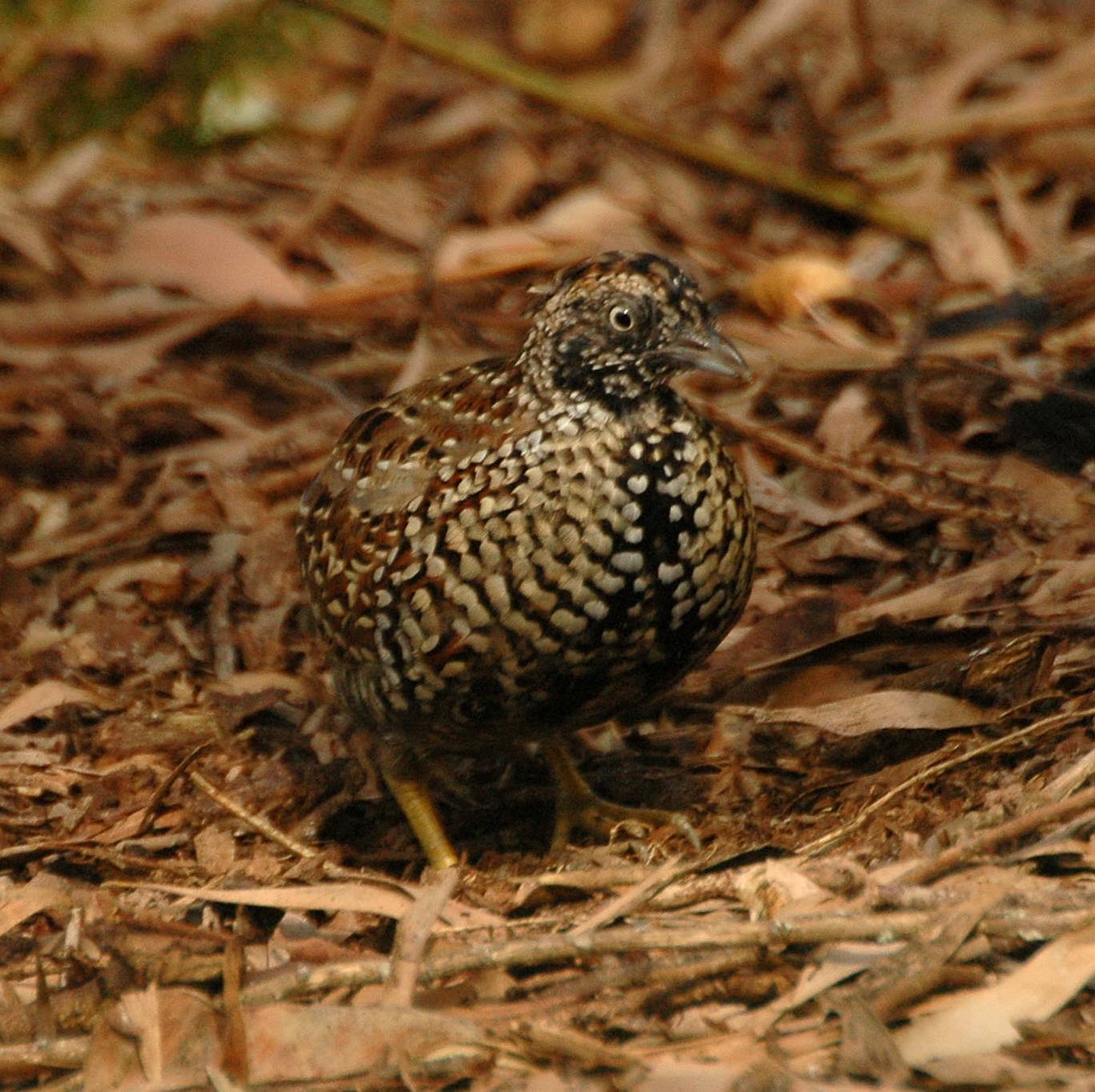
The black-breasted buttonquail is a rare buttonquail endemic to eastern Australia. As with other buttonquails, it is unrelated to the true quails. The black-breasted buttonquail is a plump quail-shaped bird 17–19 cm (6.7–7.5 in) in length with predominantly marbled black, rufous, and pale brown plumage, marked prominently with white spots and stripes, and white eyes. Like other buttonquails, the female is larger and more boldly coloured than the male, with a distinctive black head and neck sprinkled with fine white markings. The usual sex roles are reversed, as the female mates with multiple male partners and leaves them to incubate the eggs.
Region
eastern Australia
Typical Environment
Occurs patchily in coastal and subcoastal eastern Australia, centered in southeast Queensland with outliers into far northeastern New South Wales. Prefers semi-evergreen vine thickets, dry rainforest, and littoral rainforest remnants on sandy or loamy soils. Often uses dense understorey, including lantana tangles, for cover and foraging. Populations are highly localized and tied to intact leaf-litter floors and shrubby understory.
Altitude Range
Sea level to 600 m
Climate Zone
Subtropical
Ease of Keeping
Beginner friendly: 1/5
This secretive ground-dweller creates distinctive circular ‘platelets’ in leaf litter by pivoting on one foot while foraging. Unlike most birds, sex roles are reversed: the larger, more colorful female courts multiple males, which then incubate the eggs and rear the chicks. It has striking white irises and relies on dense vine thickets and dry rainforest, habitats that have been heavily fragmented.


Illustrations of male (above) and female (below) by John Gould
Temperament
solitary and secretive
Flight Pattern
reluctant flier with short rapid wingbeats
Social Behavior
Shows reversed sex roles: females are polyandrous and advertise territories; males incubate and brood. Nests are shallow ground scrapes concealed in dense cover, typically with 3–4 eggs. Usually encountered singly or in pairs and keeps to thick undergrowth.
Migratory Pattern
Resident
Song Description
Females give a low, resonant booming ‘oom… oom…’ call that carries through thickets, especially at dawn and dusk. Males produce softer whistles and clucking notes near the nest.
Plumage
Plump, quail-like with marbled black, rufous, and pale brown upperparts heavily spotted and streaked white. Female shows a bold black head and breast finely speckled white; male is duller with less black on the head and chest. Underparts are barred and mottled, giving a scaly appearance.
Diet
Feeds mainly on leaf-litter invertebrates such as ants, termites, beetles, cockroaches, spiders, and small snails. Will also take seeds and small fruits opportunistically. Foraging creates round ‘platelets’ where the bird has rotated to expose prey.
Preferred Environment
Forages on the forest floor under dense vine thickets and dry rainforest edges, especially where deep leaf litter accumulates. Frequently uses weedy tangles and lantana patches as cover while feeding.


