

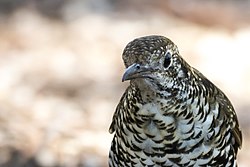
The Bassian thrush, also known as the olive-tailed thrush, is a medium-sized mostly insectivorous thrush found from northern Queensland to southeastern Australia. It also occurs in Tasmania, on some larger islands of Bass Strait, and on Kangaroo Island. The thrushes range from 27 to 29 cm in length and average 100 g (3.5 oz) in weight.
Region
Eastern and southeastern Australia, including Tasmania
Typical Environment
Found from the uplands of northern Queensland down the Great Dividing Range through New South Wales and Victoria, and west to parts of South Australia including Kangaroo Island. It is widespread in Tasmania and some Bass Strait islands. Prefers dense, wet forests such as temperate rainforest, cool wet sclerophyll, and ferny gullies, often near creeks. Usually keeps to shaded understory with abundant leaf litter where it forages on the ground. Avoids open woodlands and heavily cleared or disturbed habitats.
Altitude Range
Sea level to 1600 m
Climate Zone
Temperate
Ease of Keeping
Beginner friendly: 1/5
This thrush is famous for using stone ‘anvils’ to smash snail shells before eating the contents. Its cryptic, lunulated plumage and ventriloquial song make it surprisingly hard to locate on the forest floor. It relies on deep, moist leaf litter and is sensitive to habitat fragmentation and predation by cats and foxes.



Temperament
shy and secretive
Flight Pattern
short rapid wingbeats, low direct dashes between cover
Social Behavior
Usually solitary or in pairs, maintaining territories on the forest floor. Monogamous breeders that build a neat cup nest in tree forks, shrubs, or on tree ferns. Clutches typically contain 2–3 eggs, and both adults contribute to care near the nest.
Migratory Pattern
Partial migrant
Song Description
A clear, fluting series of whistles delivered at measured pace, often with ventriloquial quality that makes the singer hard to pinpoint. Calls include thin, high seeps and soft contact notes, most active at dawn and dusk.
Plumage
Upperparts brown to olive-brown with fine mottling; underparts buff to whitish with bold black crescent-shaped spots (lunules). Tail olive-brown; wings barred and mottled. Plumage is dense and cryptic, blending with leaf litter.
Diet
Feeds mainly on ground-dwelling invertebrates such as beetles, ants, caterpillars, earthworms, and snails. Known to crack snail shells against stones used as anvils. Will also take small crustaceans or other soil fauna near streams and occasionally consumes berries and other soft fruits.
Preferred Environment
Forages on damp, shaded forest floors with deep leaf litter, along ferny gullies and riparian margins. Often flips leaves and probes soil and moss, working slowly and methodically under dense understory.


