

The bateleur, also known as the bateleur eagle, is a medium-sized eagle in the family Accipitridae. It is often considered a relative of the snake eagles and, like them, it is classified within the subfamily Circaetinae. It is the only member of the genus Terathopius and may be the origin of the "Zimbabwe Bird", the national emblem of Zimbabwe. Adult bateleurs are generally black in colour with a chestnut colour on the mantle as well as also on the rump and tail. Adults also have gray patches about the leading edges of the wings with bright red on their cere and their feet. Adults also show white greater coverts, contrasting with black remiges in males, gray patches on the underwing primaries and black wingtips. The juvenile bateleur is quite different, being largely drab brown with a bit of paler feather scaling. All bateleurs have extremely large heads for their size, rather small bills, large feet, relatively short legs, long, bow-like wings and uniquely short tails, which are much smaller still on adults compared to juvenile birds.
Region
Sub-Saharan Africa
Typical Environment
Occurs widely across open and lightly wooded savannas, bushveld, and semi-arid regions, avoiding dense forests and the most barren deserts. It soars over large territories, often patrolling roads and waterholes where carrion is likely. Nests are usually placed high in isolated trees within open landscapes. It can be locally common in protected areas but has declined in regions with poisoning and habitat loss.
Altitude Range
Sea level to 3000 m
Climate Zone
Tropical
Ease of Keeping
Beginner friendly: 1/5
The bateleur is the sole member of the genus Terathopius and is famed for its rocking, acrobatic flight—its name comes from French for tightrope walker. Adults show striking red facial skin, cere, and legs, and an extremely short tail that makes the wings look very long. It is often associated with African culture and is thought to have inspired the Zimbabwe Bird emblem.


Close-up of head
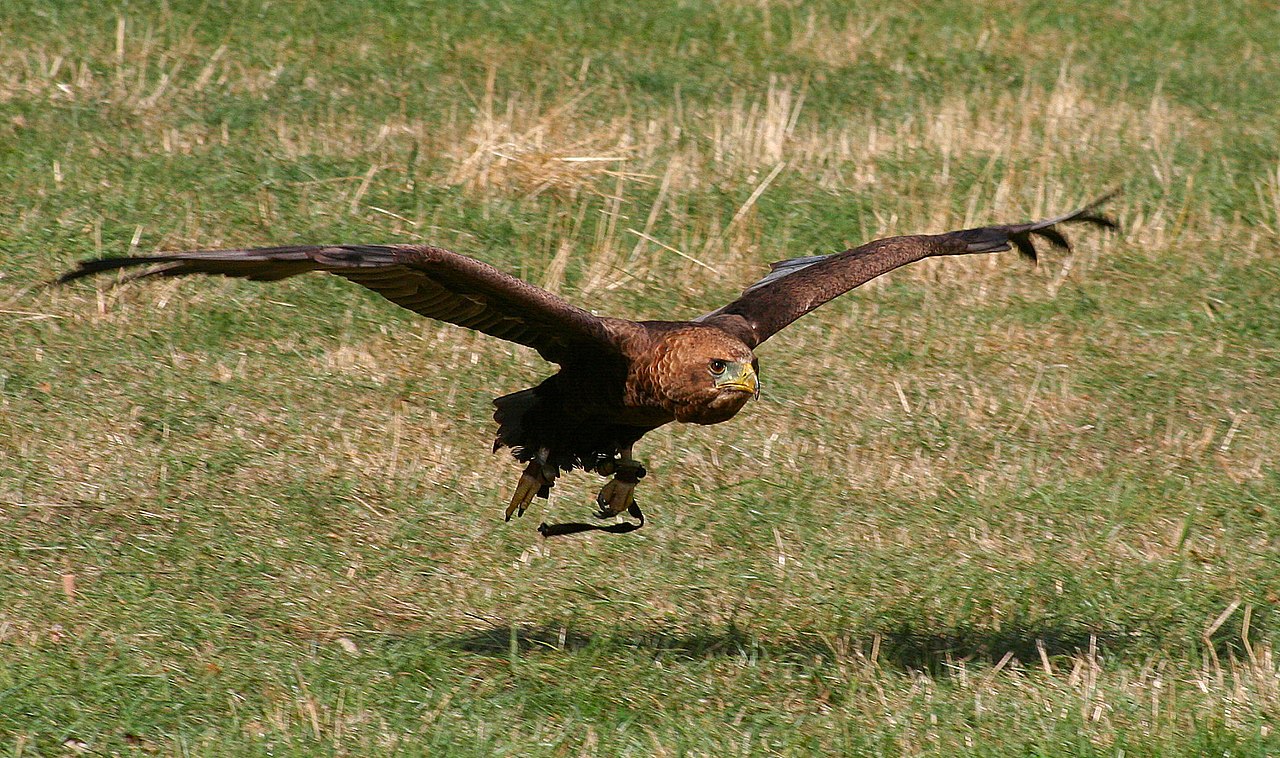
A captive immature bateleur

Adult female bateleurs show more grey to the wing than males.

The practically unmistakable form of a bateleur in flight.

A savannah bateleur in Bénin

An adult and juvenile in characteristic savanna habitat in Botswana.

A juvenile bateleur flying while carrying a bird's foot in its mouth.

Bateleur sunbathing by a waterhole

A bateleur feeding on a hare.

The markedly rough, large and short-clawed foot of a captive adult bateleur.

Juvenile bateleur with avian prey.

Male at Maasai Mara with a coqui francolin kill.

A bateleur depicted killing a young jackal.

A juvenile bateleur with a tawny eagle (Aquila rapax), a similar eagle in life history.

A bateleur on its nest.

A bateleur in "heraldic" pose.


Temperament
solitary and territorial
Flight Pattern
soaring glider with distinctive side-to-side rocking motion
Social Behavior
Usually seen alone or in pairs, maintaining large territories. Pairs are monogamous and nest high in tall trees, often reusing nest sites. They lay a single egg and both adults share incubation and chick-rearing.
Migratory Pattern
Resident
Song Description
Generally quiet, but gives high, yelping or barking calls near the nest or during aerial displays. Vocalizations are sharper and more frequent during the breeding season.
Plumage
Adult largely black with rich chestnut mantle, rump, and tail base, contrasting pale grey panels on the upperwing and white greater coverts; black flight feathers with grey patches on underwing primaries and black wingtips. Juveniles are mostly drab brown with scaly-looking pale edges to feathers and a longer tail. Feathers are tight and sleek, enhancing the bird’s streamlined silhouette.
Diet
An opportunistic raptor that hunts small to medium-sized birds, mammals, and reptiles, and readily scavenges carrion. It often locates carcasses by soaring at height and watching the behavior of other scavengers. Roadkill, poisoned carcasses, and burnt areas after fires can attract them, where they pick off prey and scraps.
Preferred Environment
Feeds over open savannas, woodland edges, and semi-deserts, exploiting thermals for long patrols. Frequently forages along roads and at waterholes where animals congregate.


