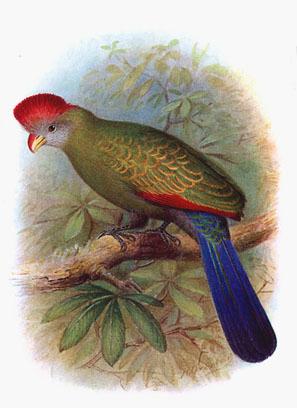
Bannerman's turaco is a species of bird in the family Musophagidae. It is endemic to Cameroon. In French it is known as touraco de Bannerman or touraco doré. Its scientific and common names honour the ornithologist David Armitage Bannerman. Its natural habitat is subtropical or tropical moist montane forests. It is threatened by habitat destruction and the International Union for Conservation of Nature has listed it as an "endangered species".
Region
Cameroon Highlands
Typical Environment
Occurs in subtropical to tropical moist montane forests of the Bamenda Highlands, favoring mature canopy and forest edges. It also uses secondary forest, riparian gallery strips, and fruiting trees in farmland adjacent to intact forest. Pairs and small groups move through the mid to upper canopy, rarely descending to the ground. Nesting typically occurs within dense foliage in well-structured forest.
Altitude Range
1600–2600 m
Climate Zone
Highland
Ease of Keeping
Beginner friendly: 2/5
Bannerman's turaco is a canopy-dwelling turaco restricted to the Bamenda Highlands of Cameroon and named after ornithologist D. A. Bannerman. Like other turacos, it shows brilliant crimson underwings in flight due to the copper-based pigment turacin. Its golden-olive crest is distinctive among green turacos. Ongoing loss of montane forest has driven significant declines, and it is listed as Endangered.


Temperament
shy and wary
Flight Pattern
short rapid wingbeats with gliding between trees
Social Behavior
Typically found in pairs or small family groups that keep to the canopy. Monogamous pairs build a flimsy stick platform hidden in dense foliage. Clutch size is usually two eggs, with both parents incubating and provisioning the chicks.
Migratory Pattern
Resident
Song Description
Vocalizations are loud, gruff, and barking, carrying over long distances in the forest. Calls often consist of repeated harsh notes or cackling series during territorial or contact displays.
Plumage
Largely mossy-green with a contrasting golden-olive crest and bluish sheen on the mantle; primaries are deep crimson, flashing vividly in flight.
Diet
Primarily frugivorous, feeding on a variety of forest fruits and berries, especially figs. Also takes flowers, buds, and young leaves when fruit is scarce, and may occasionally ingest small invertebrates incidentally. Foraging is deliberate, with birds moving methodically through fruiting crowns.
Preferred Environment
Feeds mainly in the mid to upper canopy of mature montane forest and at forest edges. Will visit fruiting trees in secondary growth and agroforestry plots near intact forest.