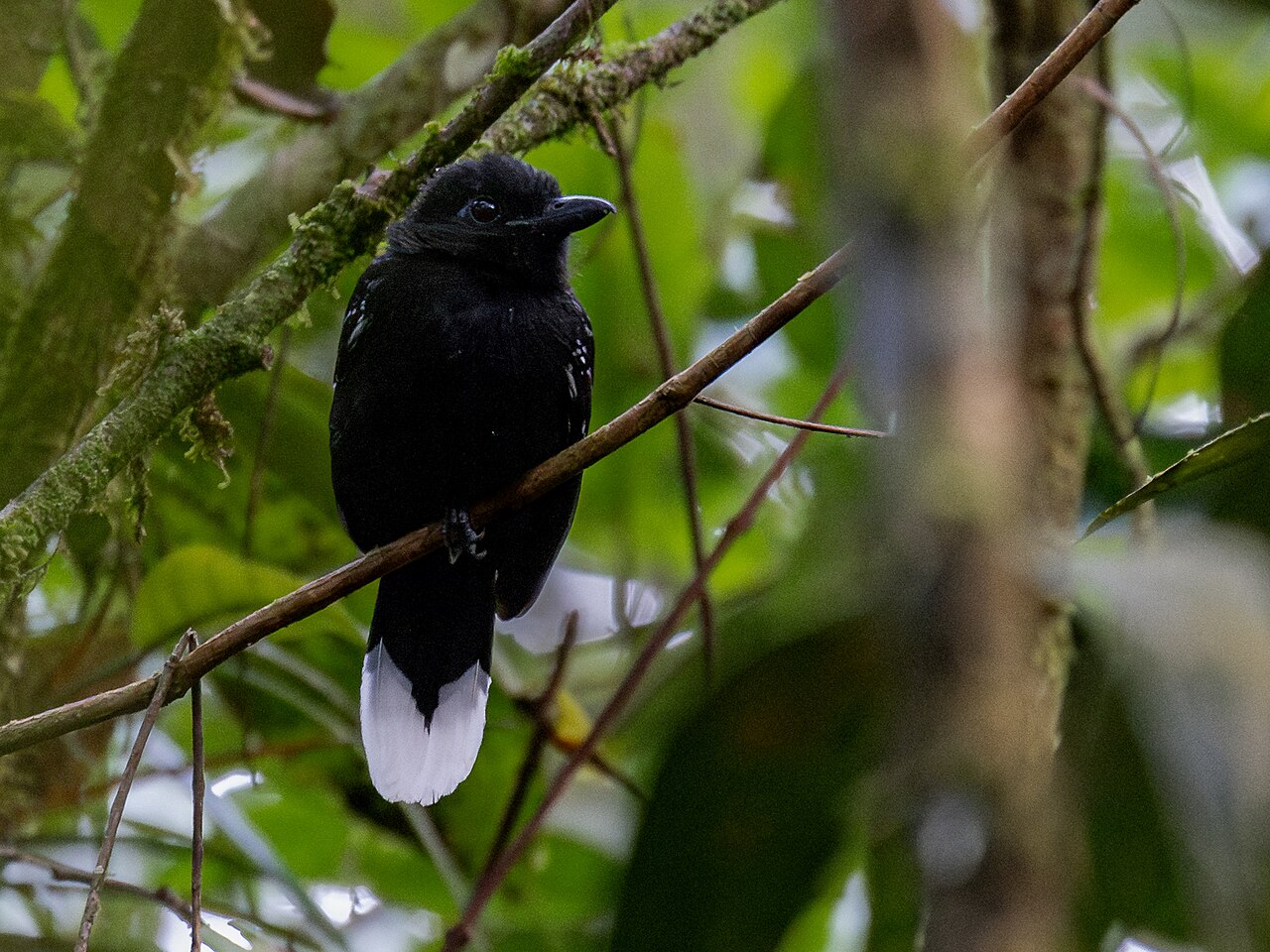
The band-tailed antbird is a species of bird in subfamily Thamnophilinae of family Thamnophilidae, the "typical antbirds". It is found in Bolivia, Brazil, Colombia, and Peru.
Region
Western and central Amazon Basin
Typical Environment
The band-tailed antbird occurs along lowland rivers and oxbow lakes in Bolivia, Brazil, Colombia, and Peru. It favors seasonally flooded várzea and igapó forests, tangled river-edge scrub, and thickets on river islands. It keeps to dense understory and tangles within a few meters of the ground or water. Local distributions can shift with river dynamics and successional changes along sandbars and islands.
Altitude Range
Sea level to 600 m
Climate Zone
Tropical
Ease of Keeping
Beginner friendly: 1/5
Despite its name, this antbird is not an obligate ant-follower and more often gleans insects in dense riverside thickets. Pairs maintain small territories along slow-moving Amazonian waterways and frequently duet. The bold white band at the tail tip is often flashed during short hops and pair communication.


Temperament
secretive and pair-territorial
Flight Pattern
short rapid wingbeats with low, darting flights
Social Behavior
Usually found in pairs that skulk through river-edge thickets and maintain small linear territories. Pairs often engage in duets and coordinated foraging, keeping close visual contact. Nests are placed low in dense vegetation near water.
Migratory Pattern
Resident
Song Description
A series of thin, clear whistles and short churring phrases, often given antiphonally by a pair. Calls include sharp chips used for contact in dense cover.
Plumage
Male is dark slate-gray to blackish with a conspicuous white terminal band on the tail; female is warmer brown with paler, buffy underparts and the same white tail band. Both sexes show subtle pale spotting or edging on the wings and a clean, contrasting tail tip. Feathers appear smooth and close-fitting, aiding movement through dense vegetation.
Diet
Feeds primarily on insects and other small arthropods gleaned from leaves, stems, and root tangles. It makes short sallies to snatch prey from low foliage and exposed surfaces near the water’s edge. Occasionally attends small ant swarms but is not an obligate follower.
Preferred Environment
Forages in dense riverside scrub, flooded forest understory, and vegetation mats around oxbow lakes and river islands. It keeps within 0–2 m of the ground or water where cover is thickest.