
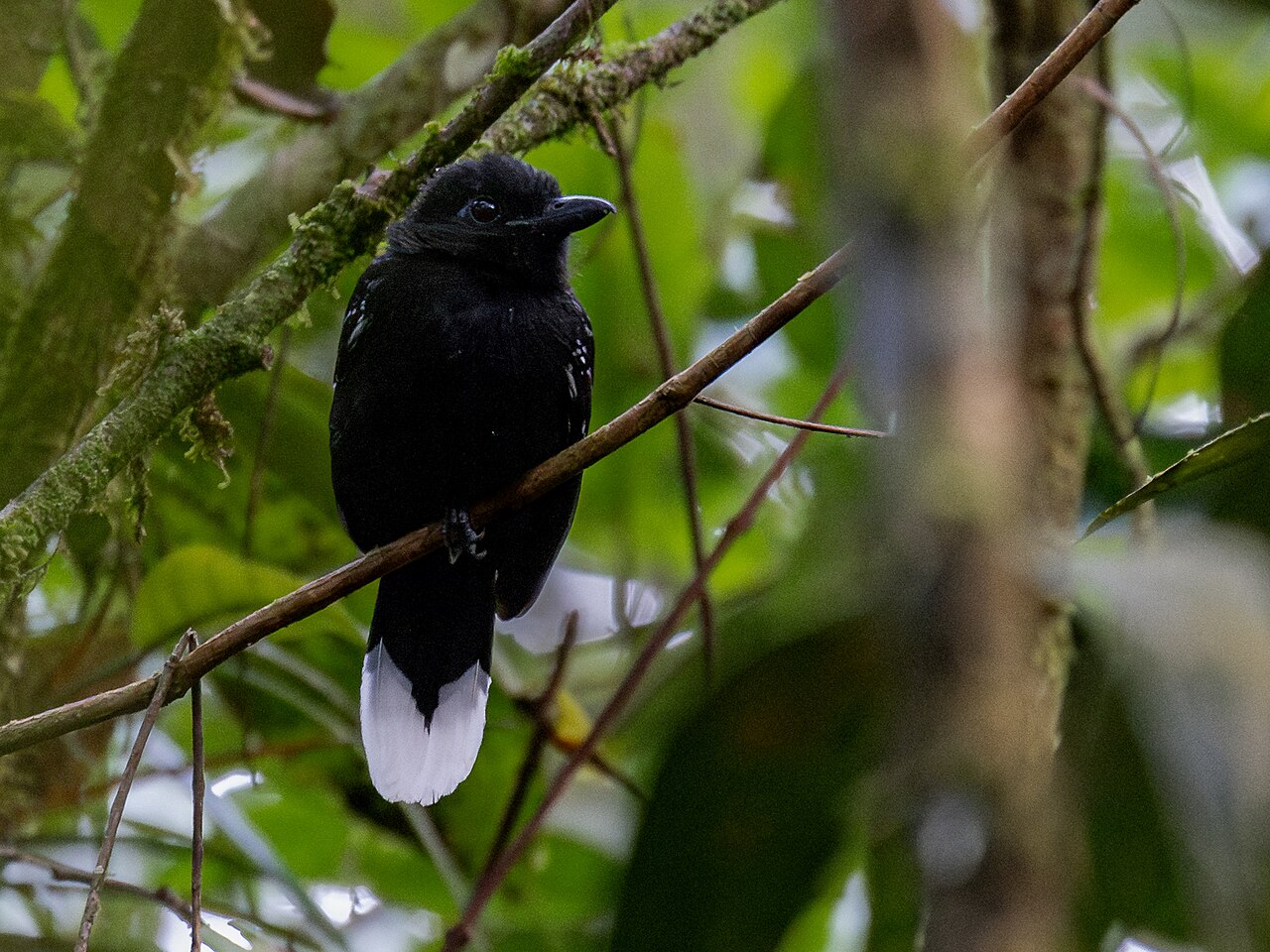
The band-tailed antshrike is a species of bird in subfamily Thamnophilinae of family Thamnophilidae, the "typical antbirds". It is found in Brazil, French Guiana, Guyana, and Suriname.
Region
The Guianas and northern Amazon Basin
Typical Environment
Occurs in northeastern South America, especially in Brazil (Amapá and northern Pará), French Guiana, Guyana, and Suriname. It inhabits lowland tropical forests, including terra firme and secondary growth, and favors dense vine tangles and thickets. Often found along forest edges, river margins, and clearings where understory is dense. It is generally a bird of the lowlands rather than higher elevations.
Altitude Range
Sea level to 500 m
Climate Zone
Tropical
Ease of Keeping
Beginner friendly: 1/5
A shy understory antshrike of the Guianan lowlands, it is most often detected by its ringing duet between male and female. The male shows bold white tail bands that flash in short hops through dense thickets, a key field mark that inspired its name. It typically travels in pairs and may skulk near forest edges and riverine tangles.


Temperament
solitary and territorial
Flight Pattern
short rapid wingbeats
Social Behavior
Usually encountered in pairs that maintain territories and move low through dense cover. They build a small cup nest in shrubs or vines and share nesting duties. Not typically in large flocks, though may join mixed-species understory parties briefly.
Migratory Pattern
Resident
Song Description
Song is a clear, ringing series of whistles, often delivered as a male–female duet with alternating phrases. Calls include sharp chips and scolds given from concealed perches.
Plumage
Male is dark slaty to blackish with contrasting white tail bands and pale wing bars; female is warm rufous-brown with paler underparts and a banded tail. Both sexes have dense, smooth plumage suited to the understory.
Diet
Feeds primarily on insects and other small arthropods such as spiders and caterpillars. It gleans prey from leaves, twigs, and vine tangles, and may sally short distances to snatch insects. Occasionally attends the edges of army-ant swarms but is not an obligate ant follower.
Preferred Environment
Forages in dense understory of lowland forest, secondary growth, and along forest edges and riparian thickets. Typically keeps within a few meters of the ground where cover is thick.


