The bald eagle is a bird of prey found in North America. A sea eagle, it has two known subspecies and forms a species pair with the white-tailed eagle, which occupies the same niche as the bald eagle in the Palearctic. Its range includes most of Canada and Alaska, all of the contiguous United States, and northern Mexico. It is found near large bodies of open water with an abundant food supply and old-growth trees for nesting.
Region
North America
Typical Environment
Bald eagles occur from Alaska and Canada through most of the contiguous United States and into northern Mexico. They are most common near coasts, large lakes, reservoirs, and major rivers with ample fish and suitable tall trees or cliffs for nesting. Winter concentrations form where water remains unfrozen and food is abundant. They use both pristine and human-altered landscapes if foraging and nesting needs are met. In migration and winter they gather at salmon runs, waterfowl staging areas, and open-water leads.
Altitude Range
Sea level to 3000 m
Climate Zone
Temperate
Ease of Keeping
Beginner friendly: 1/5
Despite the name, it isn’t bald—the term refers to the white, “piebald” head. It is the national bird and symbol of the United States and rebounded dramatically after DDT bans and conservation actions. Juveniles are mottled brown and take about 4–5 years to acquire the distinctive white head and tail.


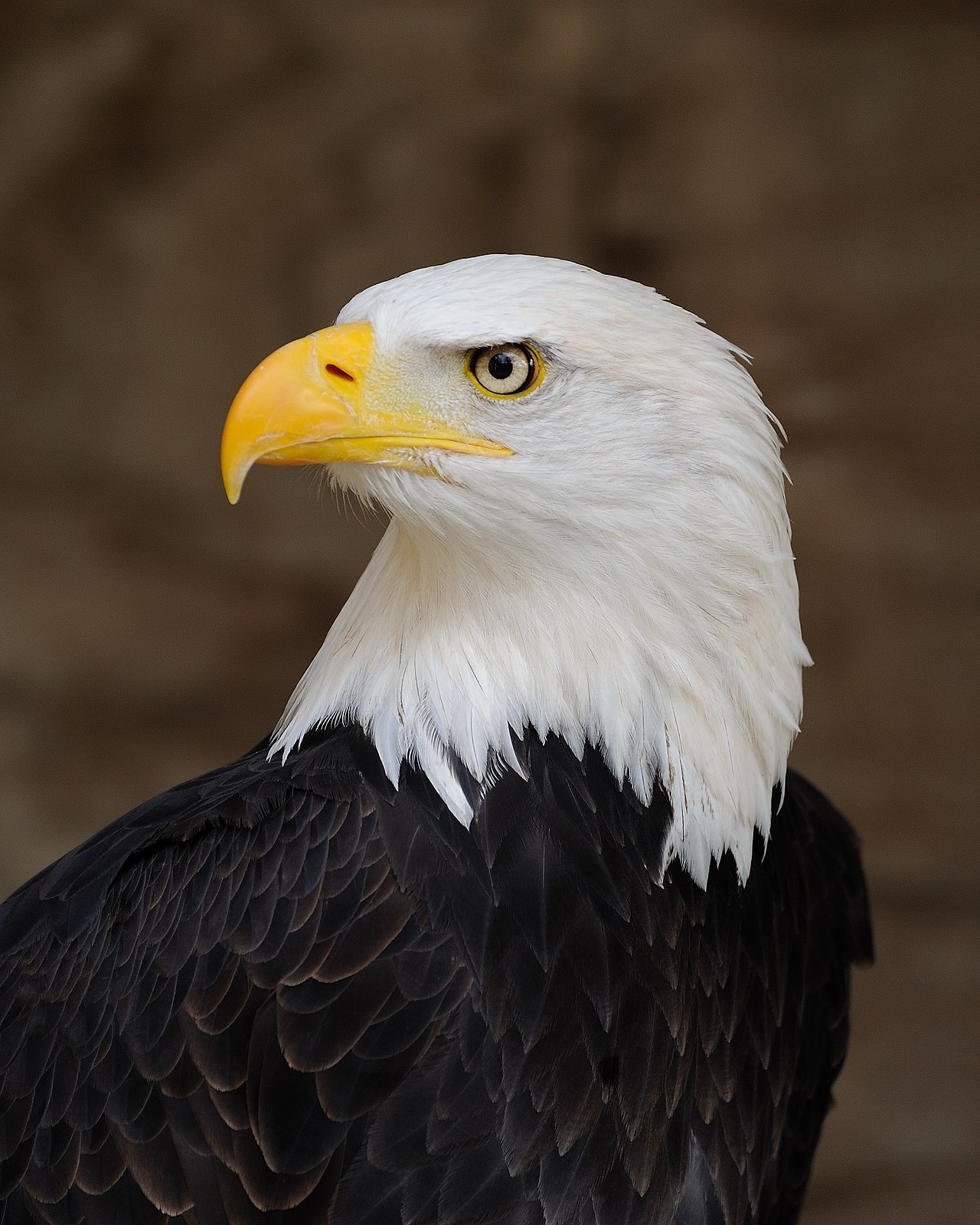
Closeup of the eponymous white head

Bald eagle plumage

Bald eagle anatomy

An individual bald eagle at various stages of plumage between nestling and adult. Images show the same bird as a nestling, at 1 year, 2 years, 3 years, 4 years, and 5 years old. Note the lightening of the eye, the yellowing of the beak, and the whitening of the eponymous head.

A bald eagle showing its wingspan

Closeup of a museum specimen's foot, showing the toepads' spiny papillae

Bald eagle in flight near Hawkesville, Canada

In flight during a licensed performance in Ontario, Canada

During training at the Canadian Raptor Conservancy

With freshly caught fish in Kodiak

Juvenile with salmon, Katmai National Park

In flight with freshly caught fish
![Feeding on catfish and other various fishes.[73] Painted by John James Audubon.](https://upload.wikimedia.org/wikipedia/commons/thumb/4/40/31_White-headed_Eagle.jpg/1280px-31_White-headed_Eagle.jpg)
Feeding on catfish and other various fishes.[73] Painted by John James Audubon.

Bald eagle attacking an American coot

A bald eagle prepares to pick off a common murre from Colony Rock in Oregon Islands National Wildlife Refuge, Oregon, United States.

Carrying a caught cottontail rabbit in Seedskadee National Wildlife Refuge

A bald eagle on a whale carcass

Pursuing an osprey to steal fish

Bald eagles with talons locked together in a mating dance spiral free-fall dive

Mating

Bald eagle egg, Collection at Museum Wiesbaden in Germany

Adult and chick

Chick at Everglades National Park

Newly fledged juvenile

Inside a waste collection and transfer facility, in Homer, Alaska, United States

First-year juvenile bald eagle at Anacortes, Washington, United States

Lady Baltimore, a bald eagle in Alaska who survived a poaching attempt, in her Juneau Raptor Center mews, on August 15, 2015

National Eagle Repository processing a bald eagle carcass for Native American use

Seal of the president of the United States
Temperament
solitary and territorial
Flight Pattern
soaring glider with powerful, deliberate wingbeats
Social Behavior
Pairs are typically monogamous and may mate for life, reusing and enlarging huge stick nests year after year. Nests are placed in tall trees or on cliffs with a commanding view of water. Clutches usually contain 1–3 eggs, and both parents share incubation and chick-rearing.
Migratory Pattern
Partial migrant
Song Description
The voice is a series of thin, high-pitched chirps and whistles rather than a loud scream. Calls often include repeated, piping notes used in pair communication and territorial contexts.
Plumage
Adults have dark brown bodies with a bright white head and tail; juveniles are mottled brown with irregular white blotches, gradually whitening with age.
Diet
Fish is the primary food, taken by swooping to snatch prey at the surface with the talons. They also eat waterfowl, small mammals, and carrion, and readily scavenge at salmon runs or carcasses. Bald eagles frequently pirate fish from ospreys and other birds. Diet varies seasonally with availability, shifting toward carrion and waterfowl in winter.
Preferred Environment
They hunt along shorelines, lakes, and rivers, perching on tall snags or trees to watch for prey. They also patrol beaches, estuaries, and ice edges where fish or waterfowl are concentrated. In some areas they forage at landfills or fish-processing sites.