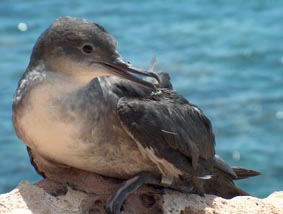
The Balearic shearwater is a medium-sized shearwater in the seabird family Procellariidae. Puffinus is a Neo-Latin loanword based on the English "puffin" and its variants, that referred to the cured carcass of the fat nestling of the Manx shearwater, a former delicacy. The specific mauretanicus refers to Mauretania, an old name for an area of North Africa roughly corresponding to Morocco and Algeria. The Balearic Shearwater is listed critically endangered by the IUCN and is one of Europe's most endangered seabirds.
Region
Western Mediterranean and Northeast Atlantic
Typical Environment
Breeds on sea cliffs and caves of Mallorca, Menorca, Ibiza, Formentera, and nearby islets. Outside the breeding season it disperses along the Iberian Atlantic coast, into the Bay of Biscay and the English Channel, with regular occurrences off Portugal, Spain, and western France, and smaller numbers reaching the UK and Ireland. At sea it favors productive shelf waters, tidal fronts, and upwellings, often close to shore. Colonies are in creviced limestone cliffs and sea caves with access directly to the water. Birds commute widely between breeding sites and feeding areas during the season.
Altitude Range
Sea level to 300 m
Climate Zone
Temperate
Ease of Keeping
Beginner friendly: 1/5
The Balearic shearwater breeds only in the Balearic Islands and spends much of the year foraging over the Western Mediterranean and adjacent Atlantic coasts. It is listed as Critically Endangered, with major threats including bycatch in longline fisheries, predation by invasive mammals at colonies, light pollution, and coastal development. Birds return to their nesting caves at night, using their mournful calls to locate mates and burrows. They are agile, low-over-wave fliers and often follow fishing vessels for discards.

Temperament
social and active
Flight Pattern
low over waves with rapid, stiff wingbeats and short glides
Social Behavior
Colonial breeder nesting in crevices and sea caves, returning to colonies at night to avoid predators. Pairs are long-term and exhibit strong site fidelity to burrows. At sea they often gather in small to medium feeding flocks, frequently associating with other shearwaters and following fishing boats.
Migratory Pattern
Seasonal migrant
Song Description
At colonies it gives eerie, wailing and chattering calls, mostly at night, used to locate mates and burrows. At sea it is generally quiet, calling only occasionally.
Plumage
Dusky brown above with dirty, mottled brownish underparts and a paler, smudgy belly; underwings show a dusky frame with a paler panel across the coverts.
Diet
Feeds mainly on small pelagic fish such as anchovy and sardine, as well as cephalopods and some crustaceans. Frequently associates with fishing vessels to take discards. Forages by surface-seizing and short pursuit-dives, sometimes diving to moderate depths. Opportunistic, switching prey with local availability and oceanographic conditions.
Preferred Environment
Productive coastal and shelf waters, tidal fronts, and upwelling zones. Often close to shore along the Iberian and French coasts but also ranges offshore where prey schools concentrate.