

The Azores bullfinch, also known as the São Miguel bullfinch, or locally in Portuguese as the priolo, is a threatened passerine bird in the true finch family. It is endemic to São Miguel Island, in the Azores archipelago of Macaronesia in the North Atlantic Ocean.
Region
Azores archipelago, North Atlantic (Macaronesia)
Typical Environment
Restricted to the humid evergreen laurel forest and adjacent thickets in the eastern highlands of São Miguel. It favors dense, mature native vegetation with abundant fruit, buds, and seeds. Birds use forest edges, clearings, and regenerating native scrub created through habitat restoration. Its range is very small and centered on the Pico da Vara–Tronqueira complex.
Altitude Range
300–1100 m
Climate Zone
Subtropical
Ease of Keeping
Beginner friendly: 1/5
Also called the priolo, this finch is confined to São Miguel in the Azores and is among Europe’s rarest songbirds. Its fortunes have improved thanks to large-scale restoration of native laurel forest and control of invasive plants. It relies heavily on endemic vegetation for food throughout the year.


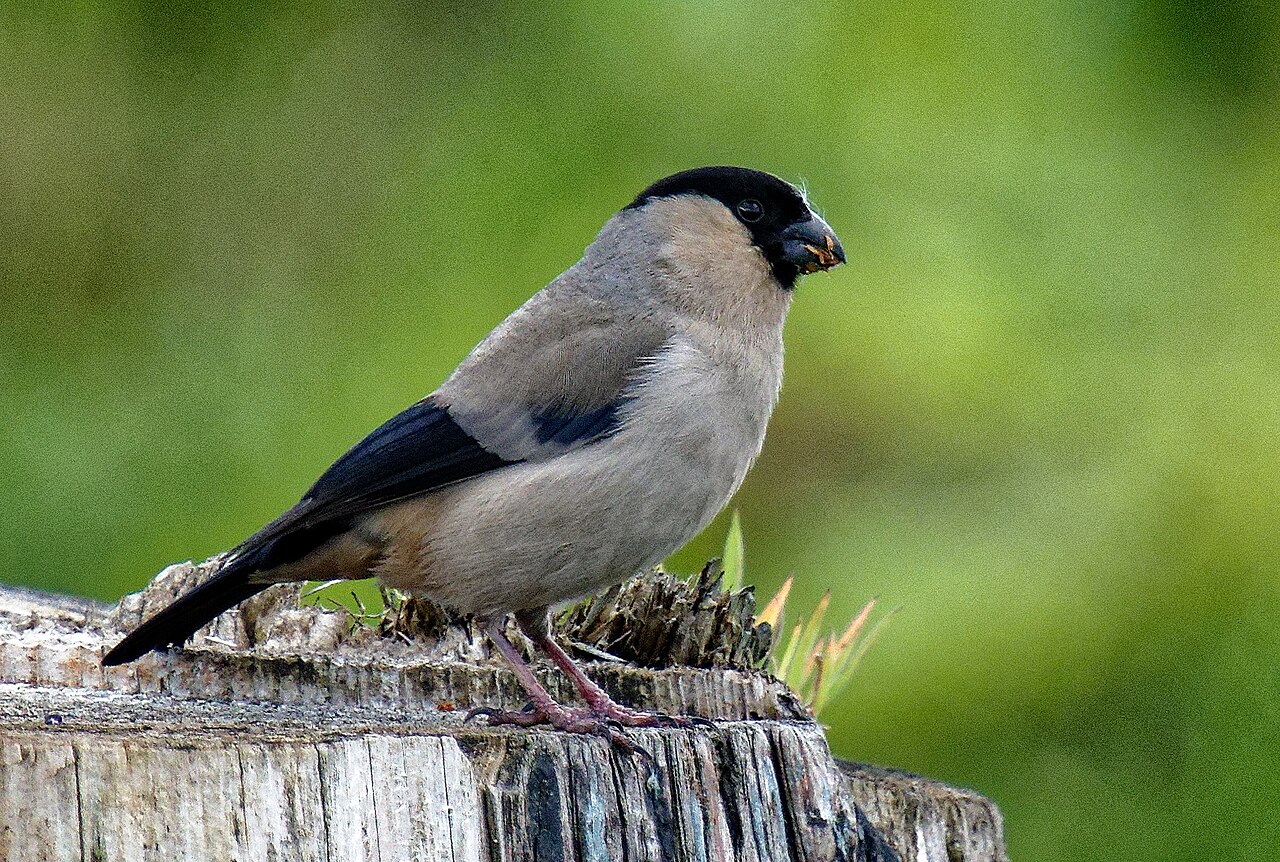
Azores bullfinch on the island of São Miguel
Temperament
shy and retiring
Flight Pattern
short rapid wingbeats with an undulating path between cover
Social Behavior
Typically found in pairs or small family groups, becoming more territorial during the breeding season. Nests are placed low to mid-level in dense shrubs or small trees within native forest. Both adults tend the young, with discreet movements and low profile around the nest.
Migratory Pattern
Resident
Song Description
Soft, melancholy whistles and piping notes, often delivered from within cover. Calls include low, plaintive ‘peuu’ notes typical of bullfinches; song is subdued and not far-carrying.
Plumage
Overall dusky grey-brown with a uniform, somewhat sooty tone; wings and tail are darker and slightly glossy. Lacks the bright red underparts of the Eurasian bullfinch, giving a muted, uniform appearance. The plumage is relatively plain with minimal wing markings.
Diet
Primarily consumes buds, seeds, and fruits of native laurel-forest plants, including species such as Azorean holly, Azorean blueberry, and laurel. It takes flower buds in spring, switches to seeds and fruits later in the year, and may strip seeds from shrubs and small trees. It may occasionally take other soft plant material when preferred foods are scarce.
Preferred Environment
Feeds within dense native thickets, along forest edges, and in regenerating patches where endemic plants are abundant. Often forages quietly inside the canopy or mid-story, dropping to lower shrubs as needed.


