

The augur buzzard is a fairly large African bird of prey. This species is distinct in typical adult plumage for its blackish back, whitish underside and orange-red tail, while juvenile augur buzzards are generally rather brown in colour; however a dark morph is known, which causes the bird's entire body to become darker. This member of the Buteo genus is distributed in several parts of the central and southern Africa, normally being found from Ethiopia to southern Angola and central Namibia. It is resident and non-migratory throughout its range. This is a species of mountains, and adjacent savannah and grassland. It is a typical buteonine raptor, being a generalist predator which tends to prefer small mammals supplemented by reptiles and birds among various prey items.
Region
East and Central African Highlands
Typical Environment
Occurs from Ethiopia and Eritrea south through Kenya, Uganda, Rwanda, Burundi, Tanzania, and into parts of the Congo Basin’s eastern escarpments, extending to northern Zambia, Malawi, Angola, and central Namibia. It favors mountains, escarpments, and adjacent open savanna, moorland, and agricultural mosaics. Nests are usually on cliffs but may be in tall trees or pylons near rugged terrain. It avoids dense lowland forests and the most arid plains but uses open country with scattered perches. Often seen along roads and ridgelines where updrafts aid soaring.
Altitude Range
1200–4500 m
Climate Zone
Highland
Ease of Keeping
Beginner friendly: 1/5
The augur buzzard is a highland raptor of eastern and central Africa, easily recognized by its orange-red tail. It often hunts by kiting into the wind or dropping from exposed perches along escarpments and open grasslands. Pairs are strongly territorial and nest on cliffs or tall trees, typically raising one to two young. It can be confused with the jackal buzzard where ranges approach, but the augur is generally more northerly and shows cleaner white underparts.


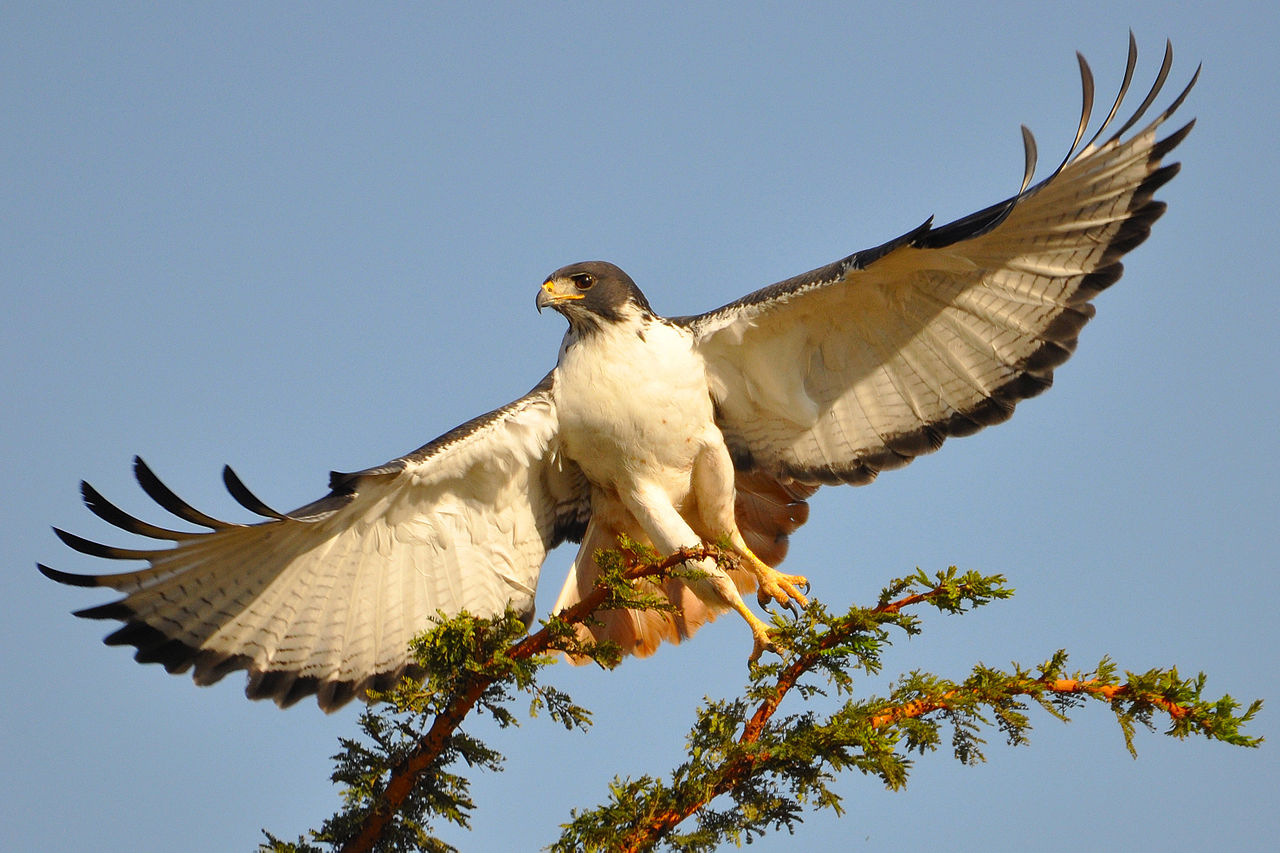
An augur buzzard in Serengeti National Park.

Gatamayu Forest - Kenya


Temperament
solitary and territorial
Flight Pattern
soaring glider that frequently hovers (kites) in wind
Social Behavior
Typically forms long-term monogamous pairs that defend territories year-round. Nests are large stick platforms on cliffs or tall trees, with 1–2 eggs laid. Both parents incubate and feed the young, with fledging after several weeks. Outside the breeding season it is usually alone or in pairs, rarely forming loose aggregations where prey is abundant.
Migratory Pattern
Resident
Song Description
A loud, mewing call often given during display flights, rendered as a plaintive kwee-eee. Calls carry well over valleys and ridgelines and may be repeated in series when defending territory.
Plumage
Adults have a blackish slate back, white underparts with a contrasting dark breast band and bold black carpal patches, and a rich orange-red tail. Juveniles are brown above with streaked buffy underparts and a duller, brownish tail. A dark morph occurs, appearing mostly sooty to blackish with the rufous tail still evident. Flight shows broad wings with pale panels and dark 'wrist' patches.
Diet
A generalist predator that takes small mammals such as rodents most frequently, along with birds, reptiles (including lizards and snakes), and large insects. It will occasionally scavenge and may seize prey flushed by grass fires or agricultural activity. Hunting is typically from a perch or by hovering into the wind before a swift stoop. It also quarters slopes using updrafts to locate prey on the ground.
Preferred Environment
Feeds over open grassland, moorland, and lightly wooded farmland near cliffs and escarpments. Common along ridgelines, road verges, and fields with scattered trees or poles for perching. Often uses windy slopes where kiting is efficient.


