

Audubon's warbler is a small bird of the family Parulidae. At one time considered a distinct species, discovery of a hybrid zone between it and the myrtle warbler in 1973 has led to it being classified as a subspecies of the yellow-rumped warbler.
Region
Western North America
Typical Environment
Breeds in coniferous and mixed forests of the western mountains from British Columbia and Alberta south through the Cascades, Sierra Nevada, and Rockies to the U.S. Southwest and northern Mexico. During migration it uses a wide range of habitats including woodlands, riparian corridors, scrub, and urban parks. In winter it is common across the southwestern United States, Baja California, and much of Mexico, wandering into lowlands and coastal areas. It readily occupies edges and open forests where it can glean insects and berries.
Altitude Range
0–3500 m
Climate Zone
Temperate
Ease of Keeping
Beginner friendly: 1/5
Audubon's warbler is the western form of the yellow-rumped warbler complex and is readily recognized by its bright yellow throat and rump. It hybridizes with the Myrtle Warbler where their ranges meet, and some authorities treat it as a full species while others consider it a subspecies. Unusually for a warbler, it can digest the waxy coatings of bayberry and juniper berries, allowing many to winter farther north than most insectivorous songbirds.

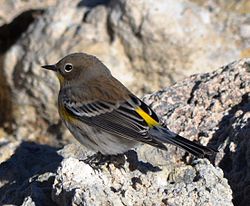
Female Audubon's warbler in summer plumage


Temperament
active and alert
Flight Pattern
short rapid wingbeats
Social Behavior
Territorial in the breeding season, forming monogamous pairs that build open cup nests on horizontal branches, often in conifers. Outside the breeding season it joins mixed-species flocks and can be quite tolerant of other small songbirds. Nests are usually placed well above the ground and are lined with fine plant fibers and hair.
Migratory Pattern
Seasonal migrant
Song Description
The song is a clear, sweet series of short trills and buzzy warbles that rise and fall, delivered from exposed perches. Call notes include a sharp, dry chek and a soft tchip used in flight and while foraging.
Plumage
Crisp, contrasting plumage with streaked gray to black upperparts and paler, lightly streaked underparts. Two bold white wingbars and a conspicuous yellow rump are present in all plumages. Males in breeding condition show darker charcoal upperparts and cleaner contrast, while females and immatures are browner and more subdued.
Diet
Primarily eats insects and other arthropods gleaned from foliage and bark or taken in short sallies. In the non-breeding season it readily consumes berries, especially bayberry, wax myrtle, and juniper, whose waxy coatings it can digest. It may also take seeds and visit suet feeders in winter when insect prey is scarce.
Preferred Environment
Forages from shrub level to the canopy in open woodlands, forest edges, riparian thickets, and parks. During migration and winter it adapts to a variety of semi-open habitats, including suburban areas with fruiting shrubs and trees.


