

The Antipodes parakeet or Antipodes Island parakeet is a parrot in the family Psittaculidae that is endemic to the Antipodes Islands of New Zealand. It is one of two parrot species found on the islands, and one of only five ground-dwelling parrots in the world. They are long-living birds that may live up to 10 years of age, but the introduction of mice that compete with them for food was a threat to their survival on the Antipodes Islands until the mice were successfully eradicated from the Islands in 2016. Unusually for parrots, they sometimes prey upon other birds, a trait shared by another New Zealand parrot, the kea.
Region
New Zealand Subantarctic Islands
Typical Environment
Found only on the Antipodes Islands, it occupies tussock grasslands, herbfields dominated by megaherbs, and coastal slopes. It forages extensively on the ground and in low vegetation, often around seabird colonies. Nest sites are typically in burrows, peat banks, or under dense tussock and rocks, providing shelter from the harsh subantarctic weather. The species uses sheltered gullies and slopes for feeding and nesting and is absent from dense forest, which does not occur on the islands.
Altitude Range
Sea level to 400 m
Climate Zone
Polar
Ease of Keeping
Beginner friendly: 1/5
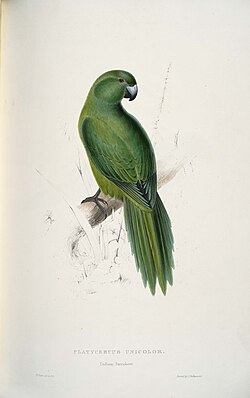
This robust, largely ground-dwelling parakeet is endemic to New Zealand’s remote Antipodes Islands and is one of only a handful of ground-dwelling parrots worldwide. Unusually for parrots, it will scavenge carrion and occasionally prey on other birds. It co-occurs with the smaller Reischek’s parakeet on the islands. The eradication of invasive mice in 2016 removed a major competitor for food and has improved the species’ outlook.




Temperament
bold and inquisitive
Flight Pattern
short rapid wingbeats; low, direct flights close to the ground
Social Behavior
Usually seen in pairs or small family groups, with larger loose aggregations where food is abundant. Pairs are monogamous and nest in burrows, peat banks, or beneath tussock clumps lined with vegetation. They may utilize abandoned seabird burrows and show strong site fidelity between seasons.
Migratory Pattern
Resident
Song Description
Calls include sharp chattering and metallic notes, with a rapid, rolling flight call. Soft twittering and contact calls are given while foraging, and louder alarm notes carry over the tussock.
Plumage
Uniform rich green to olive-green with darker wings and back; flight feathers show a bluish tinge. Plumage lacks the bright crown patches typical of many Cyanoramphus parakeets.
Diet
Primarily feeds on seeds, leaves, shoots, and flowers of tussocks and megaherbs, supplemented by berries when available. It also takes invertebrates and will scavenge carrion, including dead seabirds. Remarkably, it has been observed preying on small birds on occasion, an unusual behavior among parrots. Food items vary seasonally with plant phenology and seabird-derived resources.
Preferred Environment
Feeds on the ground and in low vegetation within tussock grasslands, herbfields, and around seabird colonies. Frequently probes soil and litter and digs with the bill to access roots and invertebrates. Sheltered gullies and leeward slopes are preferred in windy conditions.


