

The ʻapapane is a small, crimson species of Hawaiian honeycreeper endemic to the Hawaiian Islands. They are the most abundant and widely distributed honeycreeper and are found on the islands of Hawaiʻi, Maui, Lānaʻi, Kauaʻi, Molokaʻi and Oʻahu.
Region
Hawaiian Islands
Typical Environment
Found on Hawaiʻi, Maui, Lānaʻi, Kauaʻi, Molokaʻi, and Oʻahu, ʻapapane occupy native montane wet and mesic forests dominated by ʻōhiʻa and koa. They are most abundant in intact native forests but also visit forest edges, clearings, and parks wherever ʻōhiʻa is flowering. Birds move locally to track nectar sources, sometimes forming large foraging flocks. Highest densities occur in cooler highlands where mosquito numbers are low, reducing disease risk.
Altitude Range
Sea level to 2500 m
Climate Zone
Tropical
Ease of Keeping
Beginner friendly: 1/5
ʻApapane are crimson Hawaiian honeycreepers that are key pollinators of ʻōhiʻa lehua (Metrosideros polymorpha), often moving in flocks to follow blooming trees. They are the most abundant native forest bird in Hawaiʻi and can be seen on multiple islands. To avoid mosquito-borne diseases like avian malaria, they are most numerous at higher, cooler elevations. Their brush-tipped tongues help them efficiently sip nectar, and they also take small insects.


Juvenile ʻapapane
A mosquito taking a blood meal from an 'apapane
Temperament
social and active
Flight Pattern
short rapid wingbeats with swift, direct flights between flowering trees
Social Behavior
Outside the breeding season they often join loose flocks that move through the canopy to follow blooms. Breeding pairs are territorial around nest sites, constructing a cup nest high in ʻōhiʻa or other native trees. Clutches are small and both parents help feed the young.
Migratory Pattern
Partial migrant
Song Description
A lively mix of warbles, trills, buzzy notes, and squeaks, varying widely among individuals. Males sing frequently from prominent perches, and flocks can create a constant, musical chatter in flowering trees.
Plumage
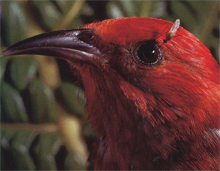
Glossy crimson body with darker brownish-black wings and tail; white to whitish-gray undertail coverts and lower belly.
Diet
Primarily nectar from ʻōhiʻa lehua, but also from other native and some non-native blossoms. Supplements nectar with small insects and spiders gleaned from foliage and bark. Uses a brush-tipped tongue and slightly decurved bill to probe flowers and occasionally hawks tiny insects mid-air.
Preferred Environment
Feeds mainly in the upper and mid-canopy of native forests, especially where ʻōhiʻa is abundant. Also forages along forest edges and in upland clearings when trees are in bloom.


