

The American goshawk is a species of raptor in the family Accipitridae. It was first described by Alexander Wilson in 1812. The American goshawk was previously considered conspecific with the Eurasian goshawk but was assigned to a separate species in 2023 based on differences in morphology, vocalizations, and genetic divergence. It was formerly placed in the genus Accipiter. It is mainly resident, but birds from colder regions migrate south for the winter. In North America, migratory goshawks are often seen migrating south along mountain ridge tops at nearly any time of the fall depending on latitude.
Region
North America
Typical Environment
Occurs across boreal and temperate forests from Alaska and western Canada east to Newfoundland, and south in suitable habitat through the Rocky Mountains, Great Lakes region, and parts of the Appalachians. Prefers extensive mature coniferous and mixed woodlands with interspersed openings and riparian corridors. Often hunts along forest edges and clearings but remains tied to dense canopy for cover and nesting. Avoids open grasslands and heavily urbanized areas. In winter, northern birds may shift southward or to lower elevations where prey is more available.
Altitude Range
Sea level to 3000 m
Climate Zone
Temperate
Ease of Keeping
Beginner friendly: 2/5
The American goshawk is a powerful forest hawk known for explosive short bursts of speed and agility between trees. It was split from the Eurasian goshawk in 2023 based on morphology, voice, and genetics. Adults show a bold white eyebrow and reddish eyes, while juveniles are brown and heavily streaked below. They are secretive and can be fiercely defensive near nests.


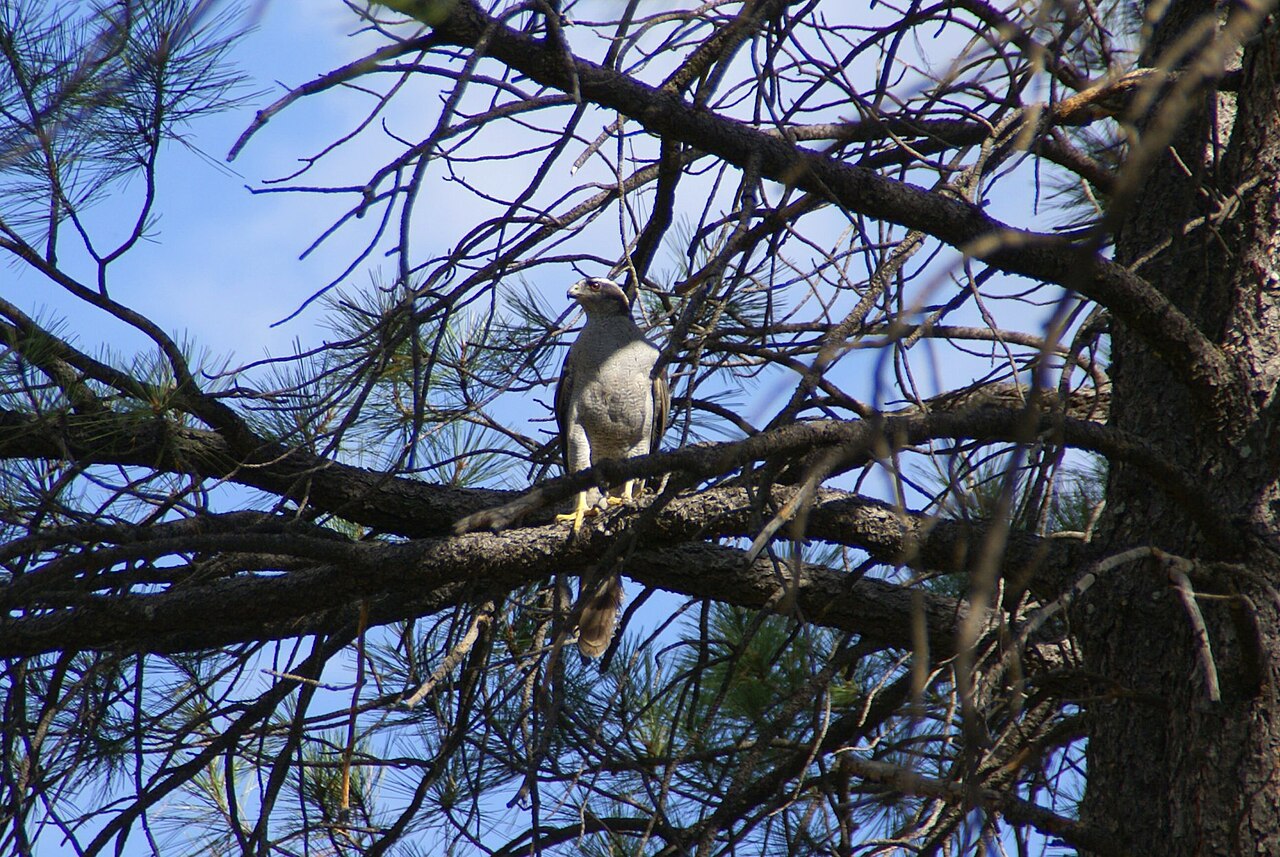
Adult in the Kaibab Plateau, Arizona, in a pine tree that typifies the habitat used locally

Large juvenile Cooper's hawks such as this one are at times mistaken for a juvenile goshawk

Two juveniles from Pennsylvania after they've become "branchers", or have left the nest but are not yet flying competently

Typical adult from the American subspecies (A. a. atricapillus) showing its strong supercilium, red eyes, black head, and blue-gray back

Prey selection frequently overlaps between goshawks and American martens, seldom will both species prey on the other

Woodpeckers such as northern flickers often fall victim to goshawks

Chasing an osprey, most likely to rob it of food, but the osprey is even considered possible prey
Temperament
solitary and territorial
Flight Pattern
rapid wingbeats with short glides; highly agile forest flier
Social Behavior
Typically monogamous and strongly territorial during the breeding season. Nests are large stick platforms placed high in mature trees, often reused for multiple years. Clutches usually contain 2–4 eggs, and adults aggressively defend nest sites against intruders.
Migratory Pattern
Partial migrant
Song Description
Vocalizations include sharp, repeated kek-kek-kek alarm calls, especially near nests. Also gives lower-pitched, rapid series of notes during territorial and courtship displays.
Plumage
Adults are slate-gray above with fine gray barring below and a contrasting white supercilium; tail is long with broad dark bands. Juveniles are brown above with coarse streaking on a buffy to whitish underside. Feathers appear dense and smooth, aiding silent flight through forest.
Diet
A versatile predator that takes medium-sized birds such as grouse, jays, and pigeons, as well as mammals like squirrels, rabbits, and hares. It hunts with sudden ambushes from concealed perches or through rapid, low-level dashes. Prey selection varies seasonally and regionally depending on availability.
Preferred Environment
Usually hunts within or along the edges of dense forests, using cover to approach prey. Frequently works along riparian corridors, forest openings, and ecotones where prey is concentrated.


