

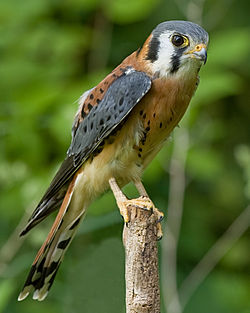
The American kestrel is the smallest and most common falcon in North America. Though it has been called the American sparrowhawk, this common name is a misnomer; the American kestrel is a true falcon, while neither the Eurasian sparrowhawk nor the other species called sparrowhawks are in the Falconidae family, hence only very distantly related to the American kestrel. It has a roughly two-to-one range in size over subspecies and sex, varying in size from about the weight of a blue jay to a mourning dove. It also ranges to South America and is a well-established species that has evolved into 17 subspecies adapted to different environments and habitats throughout the Americas. It exhibits sexual dimorphism in size and plumage, although both sexes have a rufous back with noticeable barring. Its plumage is colorful and attractive, and juveniles are similar in plumage to adults.
Region
North, Central, and South America
Typical Environment
Found from Alaska and Canada through the United States and Mexico into Central America and much of South America. It favors open habitats such as grasslands, deserts, agricultural lands, savannas, and urban parklands. It is common along roadsides and field edges where perches are abundant. As a cavity nester, it occupies natural tree holes, saguaro cavities, building crevices, and nest boxes.
Altitude Range
Sea level to 4000 m
Climate Zone
Other
Ease of Keeping
Beginner friendly: 1/5
The American kestrel is the smallest and most widespread falcon in the Americas, often seen hovering over fields or hunting from roadside wires. It shows strong sexual dimorphism: males have blue-gray wings, while females are more uniformly rufous with heavy barring. It readily uses nest boxes and natural cavities, including woodpecker holes and saguaro cacti. Distinctive black ‘eye spots’ on the nape may help deter predators.


Adult female in Winnipeg, Manitoba, Canada

Kestrel resting in an apple tree

Illustration of Falco sparverius Linnaeus: American kestrel by Ann Lee painted between 1770 and 1800

American kestrel with dragonfly, Barr Lake State Park, Colorado


Falco sparverius - MHNT

A young bird

A rehabilitated male American kestrel with handler at an educational event

Male with handler, San Diego Zoo
Temperament
alert and territorial
Flight Pattern
short rapid wingbeats with frequent hovering
Social Behavior
Typically solitary or in pairs during the breeding season, defending territories around nest sites. Mostly monogamous within a season; nests in cavities without adding much nesting material. Outside the breeding season it may gather loosely in areas with abundant prey or roost communally in severe weather.
Migratory Pattern
Partial migrant
Song Description
The call is a rapid, high-pitched killy-killy-killy given in series, especially during alarm or territorial displays. Softer chatter and whines occur at nests and during courtship.
Plumage
Compact falcon with rufous back and tail, contrasting slate-blue wings in males and rufous, heavily barred wings in females; pale underparts with variable spotting or streaking.
Diet
Primarily hunts large insects such as grasshoppers, crickets, beetles, and dragonflies. Also takes small mammals (mice, voles), small birds, and reptiles, especially outside peak insect seasons. Hunts from exposed perches or by hovering into the wind, dropping swiftly onto prey. Exceptional vision helps detect prey movement over open ground.
Preferred Environment
Open country with scattered perches, including fields, pastures, prairies, deserts, and urban edges. Common along roadsides, fence lines, and powerlines where it can scan for prey.


