

The American goldfinch is a small North American bird in the finch family. It is migratory, ranging from mid-Alberta to North Carolina during the breeding season, and from just south of the Canada–United States border to Mexico during the winter.
Region
North America
Typical Environment
Breeds from southern Canada across much of the northern and central United States, extending south to the Carolinas and parts of the interior West. Winters from the southern United States into Mexico, retreating from the coldest northern areas. Occupies weedy fields, meadows, prairies, floodplains, and open woodland edges. Common in suburban gardens and along roadsides where composite flowers and seed-bearing weeds are abundant. Avoids dense, unbroken forests but uses scattered trees and shrubs for nesting.
Altitude Range
Sea level to 2500 m
Climate Zone
Temperate
Ease of Keeping
Beginner friendly: 2/5
Breeding males are brilliant lemon-yellow with a black cap, while females and winter birds are olive-brown, reflecting a complete molt after breeding. The species nests late in summer, timing its breeding to the peak of seed plants like thistles. It is one of the few largely vegetarian songbirds, even feeding its young mostly seeds. Its undulating flight is accompanied by a distinctive 'potato-chip' call.


Female
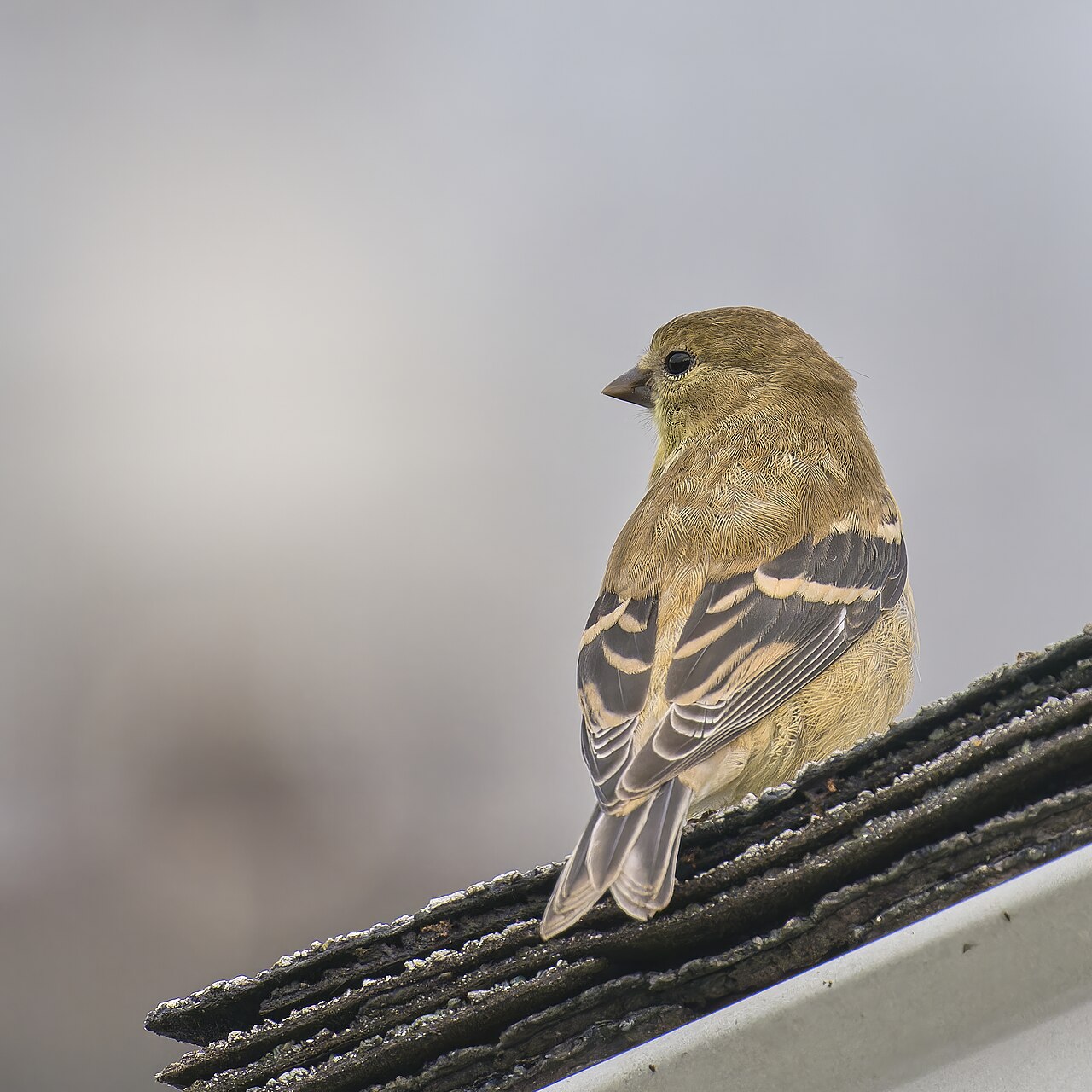
Non-breeding plumage

Male (left) and female (right) at a thistle feeder

Nest

Feeding

Feeding from sunflower heads
Temperament
social and active
Flight Pattern
undulating with short rapid wingbeats
Social Behavior
Forms loose colonies in the breeding season and often nests in small groups where seed plants are plentiful. Generally monogamous within a season, weaving neat cup nests from plant fibers and spider silk in shrubs or small trees. Outside the breeding season it gathers in sizable flocks, frequently visiting seed feeders together.
Migratory Pattern
Partial migrant
Song Description
A sweet, rolling series of twitters and trills, often delivered from exposed perches. Flight call is a distinctive rising and falling 'potato-chip' given in synchrony with its bounding flight.
Plumage
Breeding males are bright yellow with a black cap, black wings with bold white bars, and a white rump; in nonbreeding season both sexes are muted olive-brown with dusky wings. Females are duller year-round with no black cap and paler wing bars. Tail is blackish with white patches and the bill is a contrasting orange in breeding season.
Diet
Primarily seeds from composite plants such as thistles, asters, sunflowers, and coneflowers, as well as birch and alder catkins. Regularly visits feeders for nyjer (niger) and black oil sunflower seeds. Rarely takes small insects or buds, remaining one of the most strictly granivorous North American songbirds. Young are fed regurgitated seeds rather than insects.
Preferred Environment
Feeds in open weedy fields, prairie edges, and along roadsides where seed heads are accessible. Often forages acrobatically, hanging from seed heads or catkins, and readily uses backyard feeders. Also works riparian edges and disturbed areas rich in composite flowers.


