

The African penguin, also known as Cape penguin or South African penguin, is a species of penguin confined to southern African waters. It is the only penguin found in the Old World. Like all penguins, it is flightless, with a streamlined body and wings stiffened and flattened into flippers for a marine habitat. Adults weigh an average of 2.2–3.5 kg (4.9–7.7 lb) and are 60–70 cm (24–28 in) tall. The species has distinctive pink patches of skin above the eyes and a black facial mask. The body's upper parts are black and sharply delineated from the white underparts, which are spotted and marked with a black band.
Region
Southern Africa
Typical Environment
Breeds on offshore islands and a few mainland sites along the coasts of Namibia and South Africa, notably through the Benguela upwelling region to Algoa Bay. Colonies occur on rocky shores, sandy beaches with coastal scrub, and human-protected mainland sites. At sea it forages mostly over the continental shelf in cold, nutrient‑rich waters. Birds commute daily between colonies and nearby feeding grounds and range farther when prey is scarce.
Altitude Range
Sea level to 100 m
Climate Zone
Temperate
Ease of Keeping
Beginner friendly: 1/5
Also called the Cape penguin, it is the only penguin species breeding in Africa. The pink patches above the eyes help regulate body temperature by increasing blood flow when the bird overheats. Its braying call sounds like a donkey, which gave rise to the nickname 'jackass penguin'. Major threats include prey depletion, oiling, and habitat loss at breeding sites.


African penguin diving in Siam Center, Bangkok, Thailand

African penguin skeleton at the Museum of Osteology in Oklahoma City, Oklahoma, US

Two adults with chicks at the Boulders Beach colony in South Africa

Egg from the collection of Museum Wiesbaden, Wiesbaden, Hesse, Germany

Nesting burrows of the African penguin, Boulders Beach (2017)

African penguin at the New England Aquarium, Boston, Massachusetts, United States
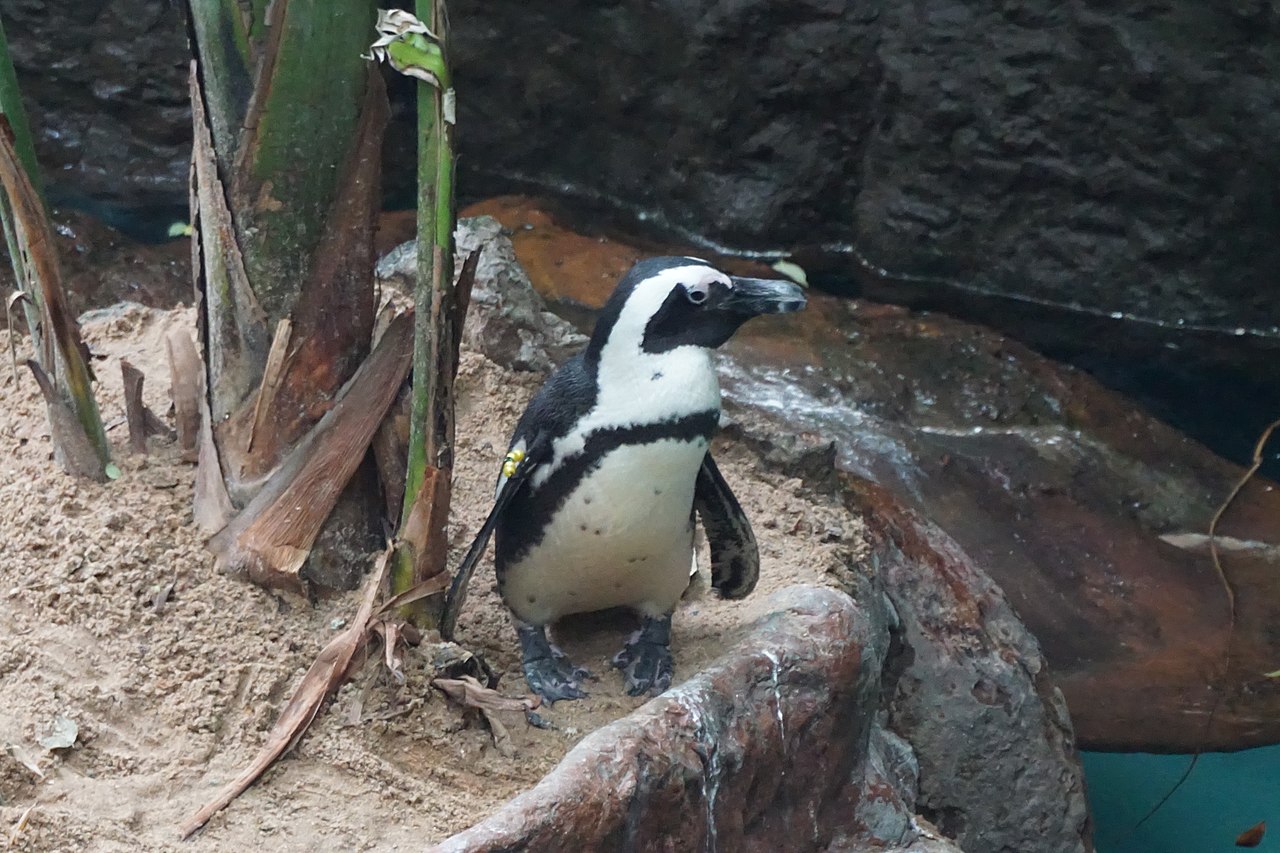
African penguin at the Dallas World Aquarium, Dallas, Texas, United States


Temperament
social and colonial
Flight Pattern
flightless; powerful underwater pursuit diver
Social Behavior
Breeds in dense colonies, often forming long-term monogamous pairs. Nests in burrows, under bushes, or in artificial nest boxes, with both parents incubating and feeding the chick(s). Adults commute between colony and feeding grounds, and juveniles disperse widely at sea before returning to breed.
Migratory Pattern
Resident
Song Description
Famous for a loud, braying 'hee-haw' reminiscent of a donkey, used in displays and contact calls. Also gives barks and growls at close range, especially during territorial interactions.
Plumage
Sharp black-and-white countershaded pattern: black upperparts and white underparts with a broad black chest band and scattered black spots on the belly.
Diet
Feeds mainly on small schooling fish such as sardine and anchovy, supplemented by squid and small crustaceans. It pursues prey underwater using rapid wing strokes and coordinated group foraging when schools are dense. Typical dive depths are 10–40 m, with occasional deeper dives when prey is deeper.
Preferred Environment
Cold, productive coastal waters associated with the Benguela Current and nearby shelf zones. Often forages within tens of kilometers of the colony but may range farther when prey shifts.


