

The African oystercatcher or African black oystercatcher is a large charismatic wader resident to the mainland coasts and offshore islands of southern Africa. This oystercatcher has a population of over 6,000 adults, which breed between November and April. The scientific name moquini commemorates the French naturalist Alfred Moquin-Tandon who discovered and named this species before Bonaparte.
Region
Southern Africa
Typical Environment
Occurs along the mainland coasts and offshore islands of Namibia and South Africa, especially on the Benguela upwelling coast. It favors wave-washed rocky shores, mussel beds, and adjacent sandy beaches, and also uses sheltered bays and estuary mouths. Birds nest just above the high-tide line on open sand, shingle, or rock ledges, often on offshore islands where disturbance and predators are fewer. They are strongly tied to the intertidal zone and rarely venture inland.
Altitude Range
Sea level to 50 m
Climate Zone
Temperate
Ease of Keeping
Beginner friendly: 1/5
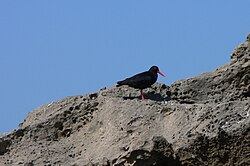
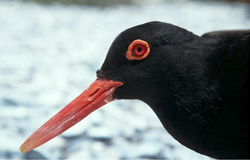
Also called the African black oystercatcher, it is a striking coastal wader with an all-black body and vivid red bill, eyes, and legs. It specializes in prying open mussels, limpets, and other shellfish with remarkable skill. Once of conservation concern due to disturbance on beaches, many populations have rebounded thanks to protected islands and managed coastal access.




Temperament
solitary and territorial
Flight Pattern
strong flier with rapid wingbeats
Social Behavior
Typically forms long-term monogamous pairs that defend coastal territories during the breeding season. Nests are simple scrapes on open substrate; both adults incubate 1–2 eggs and guard mobile chicks. Outside breeding, birds may gather at productive feeding sites or roost communally on rocks and islands.
Migratory Pattern
Resident
Song Description
Loud, piercing piping calls used in territorial displays and alarm. Pairs often give excited, repeated whistles when intruders approach nests or feeding areas.
Plumage
Uniformly black with dense, sleek plumage suited to coastal spray.
Diet
Feeds mainly on intertidal invertebrates such as mussels, limpets, oysters, other bivalves, marine worms, and small crabs. It uses its robust bill to pry, stab, or hammer shells and to exploit gaping bivalves. After storms, it scavenges beached shellfish along the wrack line. Foraging success is closely tied to low-tide exposure of rocky platforms.
Preferred Environment
Intertidal rocky shores and mussel beds, but also edges of sandy beaches, tidal pools, and estuary mudflats. Frequently works wave-splashed rock ledges and reef flats where shellfish are abundant.


