
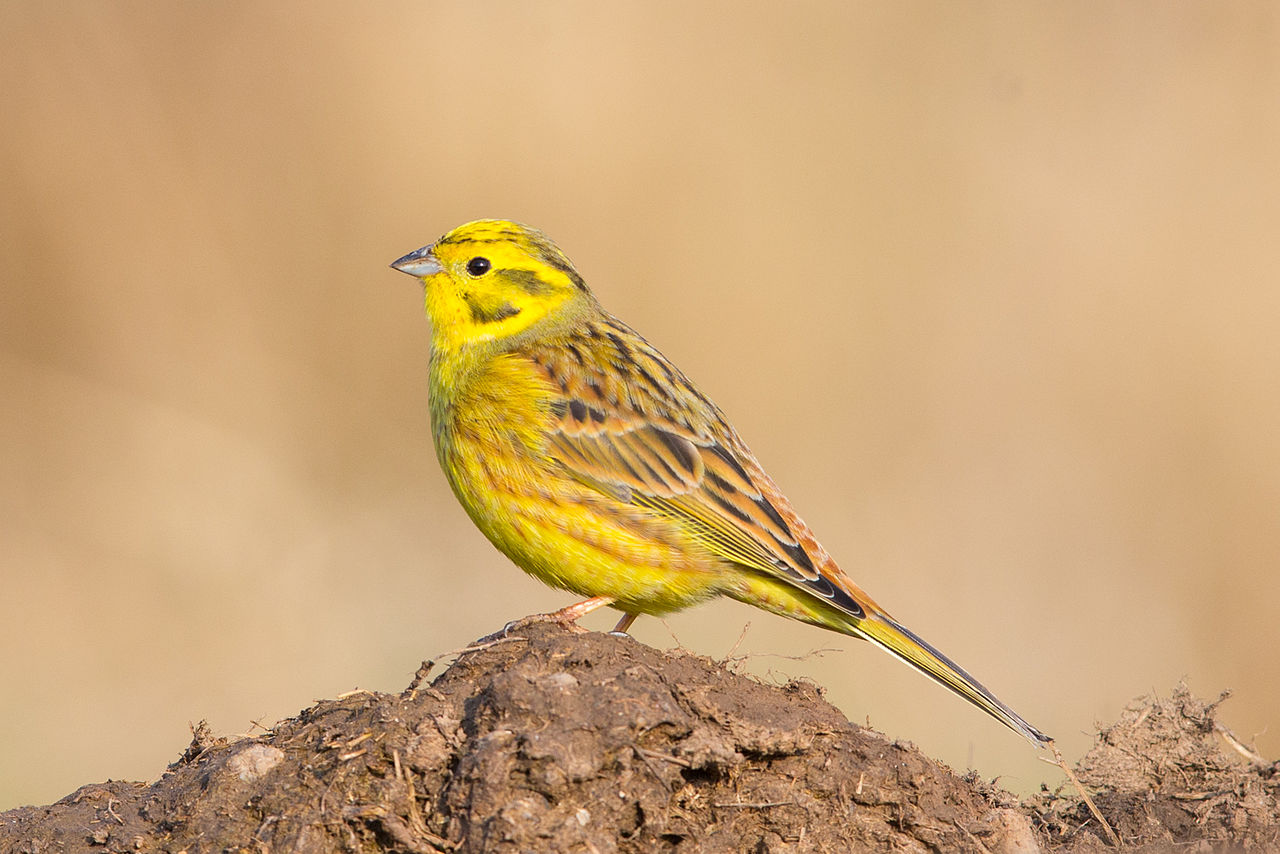
The yellowhammer is a passerine bird in the bunting family that is native to Eurasia and has been introduced to New Zealand and Australia. Most European birds remain in the breeding range year-round, but the eastern subspecies is partially migratory, with much of the population wintering further south. The male yellowhammer has a bright yellow head, streaked brown back, chestnut rump, and yellow under parts. Other plumages are duller versions of the same pattern. The yellowhammer is common in open areas with some shrubs or trees, and forms small flocks in winter. Its song has a rhythm like "A little bit of bread and no cheese". The song is very similar to that of its closest relative, the pine bunting, with which it interbreeds.
Region
Eurasia (Palearctic)
Typical Environment
Widespread across much of Europe into western and central Asia, inhabiting open country with hedgerows, scrub, field margins, and woodland edges. It favors traditional mixed farmland, meadows, and heathland edges, as well as coastal dunes and clearings. Outside its native range it has been introduced to New Zealand and parts of Australia. In winter it gathers in small flocks in stubble fields and weedy margins.
Altitude Range
Sea level to 2000 m
Climate Zone
Temperate
Ease of Keeping
Beginner friendly: 2/5
The yellowhammer’s song is famously rendered as “a little bit of bread and no cheese.” It is closely related to the pine bunting and hybridizes where their ranges meet. Introduced populations became well established in New Zealand and have been recorded from Australia.


Male E. c. caliginosa

Female

Emberiza citrinella

Traditional farmland provides good habitat for nesting and feeding.

Eggs

The Eurasian sparrowhawk is a predator of the yellowhammer.

John Clare wrote two poems about the yellowhammer.

Temperament
social and active
Flight Pattern
short undulating flights with rapid wingbeats
Social Behavior
Breeds in loose territories with pairs nesting low in shrubs, hedges, or on the ground under cover. Clutches typically contain 3–5 eggs, with two or more broods possible in a season. In winter it forms small flocks, often mixed with other buntings and finches, foraging in fields and along hedgerows.
Migratory Pattern
Partial migrant
Song Description
Males sing from hedgetops or exposed perches, delivering a clear, accelerating series of notes ending in a prolonged syllable. The mnemonic in many languages is likened to “a little bit of bread and no cheese.” Calls include sharp ticks and soft contact notes within flocks.
Plumage
Male with bright yellow head and underparts, streaked warm-brown mantle, and chestnut rump; females and juveniles are duller and more heavily streaked with a washed-yellow face. Both sexes show white outer tail feathers in flight.
Diet
Primarily eats seeds and grains from grasses and weeds, especially outside the breeding season. During spring and summer it supplements with insects and other invertebrates, which are crucial for feeding nestlings. It also takes spilled grain and weed seeds in stubble fields and farmyards. Grit is ingested to aid digestion.
Preferred Environment
Forages on the ground along field margins, stubbles, and rough grassland, and within hedgerows and scrubby edges. In winter it concentrates where seed resources persist, such as weedy patches and set-aside fields.


