

The willie wagtail is a passerine bird native to Australia, New Guinea, the Solomon Islands, the Bismarck Archipelago, and Eastern Indonesia. It is a common and familiar bird throughout much of its range, living in most habitats apart from thick forest. Measuring 19–21.5 cm in length, the willie wagtail is contrastingly coloured with almost entirely black upperparts and white underparts; the male and female have similar plumage.
Region
Australasia and Melanesia
Typical Environment
Occurs across mainland Australia and Tasmania, extending to New Guinea, the Bismarck Archipelago, the Solomon Islands, and eastern Indonesia. It favors open woodlands, scrub, farmlands, grasslands, and urban parks and gardens. It is scarce in dense rainforest and the most barren deserts but readily uses edges and clearings. Often found near water and human habitation, perching on fences, posts, and low branches.
Altitude Range
Sea level to 2000 m
Climate Zone
Other
Ease of Keeping
Beginner friendly: 1/5
The willie wagtail is a bold, highly adaptable fantail that thrives in open habitats and around human settlements. It constantly flicks and fans its long tail while foraging, a behavior thought to flush insects. Pairs are strongly territorial and will bravely mob much larger birds. Its cheerful, repetitive song is a familiar sound across much of Australasia.


Closeup showing white eyebrows flared

In flight

A well-guarded nest

Willie wagtail incubating its eggs
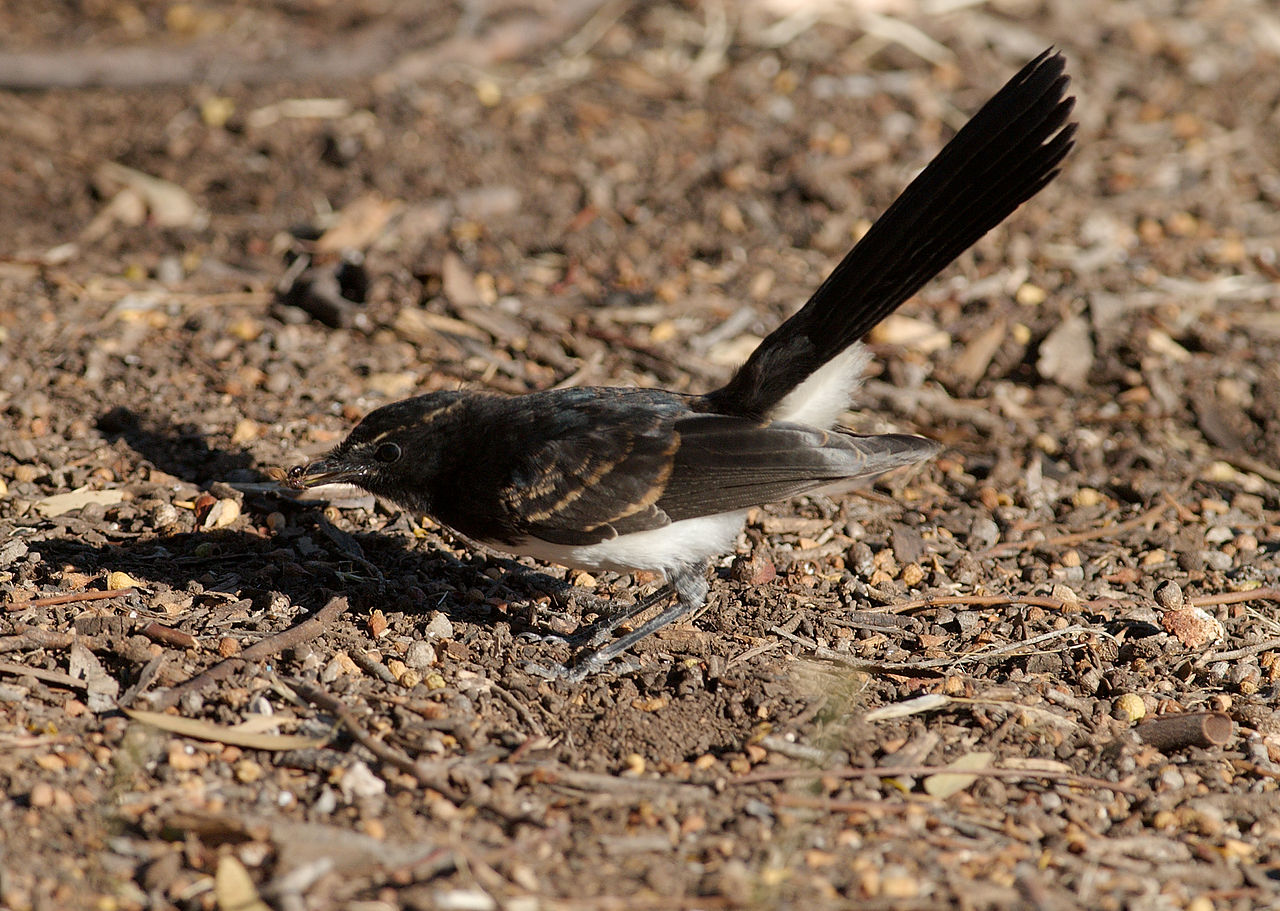
Juvenile successfully foraging

Temperament
bold and territorial
Flight Pattern
short rapid wingbeats with agile sallies
Social Behavior
Usually seen singly or in pairs that maintain year-round territories. Builds a neat, cup-shaped nest of grasses bound with spider silk on an exposed branch. Both parents incubate and feed the young, often raising multiple broods in a season. Frequently mobs larger birds and intruders.
Migratory Pattern
Resident
Song Description
Voice is clear, bright, and repetitive, often rendered as a sweet, whistled phrase. Also gives sharp scolds and chatters when alarmed or while defending territory.
Plumage
Glossy black upperparts with clean white underparts and a long, frequently fanned tail; plumage appears sharply contrasting. A pale eyebrow (supercilium) can be flared during displays. Feathers are sleek, aiding agile flight and rapid tail movements.
Diet
Primarily takes flying and ground-dwelling insects such as flies, beetles, moths, wasps, grasshoppers, and spiders. Hunts by sallying from low perches, chasing prey in short bursts, and gleaning from the ground. Tail wagging and fanning likely help flush insects from cover. Opportunistic near livestock and lights where insects concentrate.
Preferred Environment
Open ground, edges, and lightly wooded areas with scattered perches like fences and low branches. Common in parks, gardens, farms, and along watercourses where insect abundance is high.


