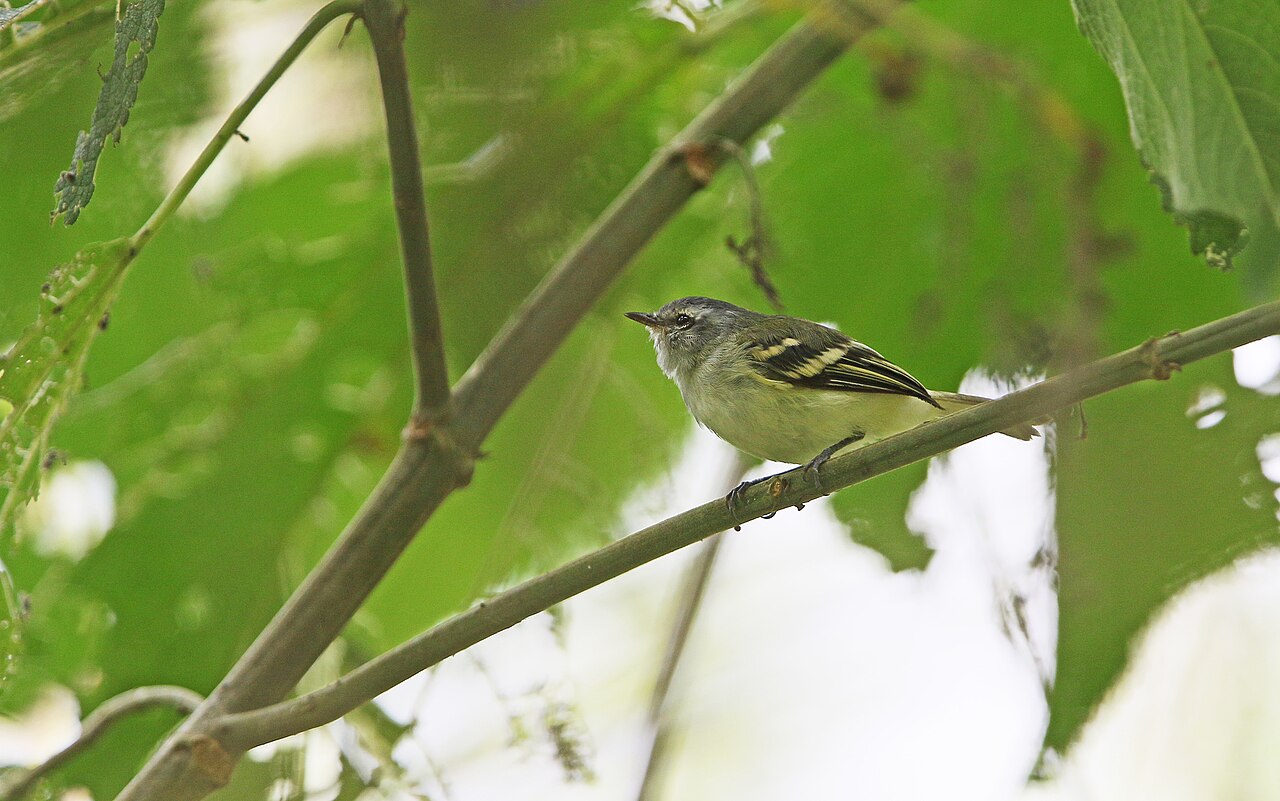
The white-tailed tityra is a medium-sized passerine bird about 19 cm long with pied plumage, mostly white or very pale grey, but with a black crown and wings.
Region
Amazon Basin
Typical Environment
Found chiefly south of the Amazon River from eastern Peru and northern Bolivia east through central and southern Amazonian Brazil. It occupies lowland rainforest, tall secondary growth, river-edge forests, and forest fragments with tall trees. The species favors canopy and emergent layers but will also use edges, clearings with scattered trees, and várzea (seasonally flooded) forest. It often occurs in lightly disturbed habitats so long as large perches and fruiting trees remain.
Altitude Range
0–1200 m
Climate Zone
Tropical
Ease of Keeping
Beginner friendly: 1/5
A canopy-dwelling member of the family Tityridae, the white-tailed tityra often perches conspicuously on high exposed branches. It feeds on both fruits and large insects, making short sallies from perches. Pairs frequently nest in old woodpecker holes and may defend nest sites vigorously. Males are cleaner white with a sharper black crown, while females show faint dusky mottling.
Temperament
social and active
Flight Pattern
direct flight with short rapid wingbeats between high perches
Social Behavior
Usually seen in pairs or small family groups and sometimes joins mixed-species flocks in the canopy. Nests in tree cavities, often reusing old woodpecker holes, and may place nests near aggressive insects such as wasps for added protection. Pairs defend territories around nest sites and deliver food to nestlings cooperatively.
Migratory Pattern
Resident
Song Description
Vocalizations are nasal and buzzing, with sharp grating notes and short rattles. Calls are often delivered from exposed perches and repeated in short series, sometimes as contact calls between mates.
Plumage
Pied appearance: mostly white to very pale gray body with a contrasting black crown and black wings; tail predominantly white. Male is cleaner white with sharper contrasts; female tends to show faint dusky or buffy mottling on underparts.
Diet
Feeds heavily on small to medium fruits such as figs and berries, swallowing them whole and dispersing seeds. Also takes large insects including grasshoppers, katydids, caterpillars, and beetles, often by sallying from a perch. Occasionally snaps up small vertebrates or other arthropods when available. Foraging is typically deliberate, with frequent pauses to scan from high vantage points.
Preferred Environment
Primarily forages in the upper canopy and along forest edges where fruiting trees are abundant. Also uses river margins, clearings with tall remnant trees, and secondary forest. Will descend to midstory when pursuing insects or visiting fruiting shrubs.