
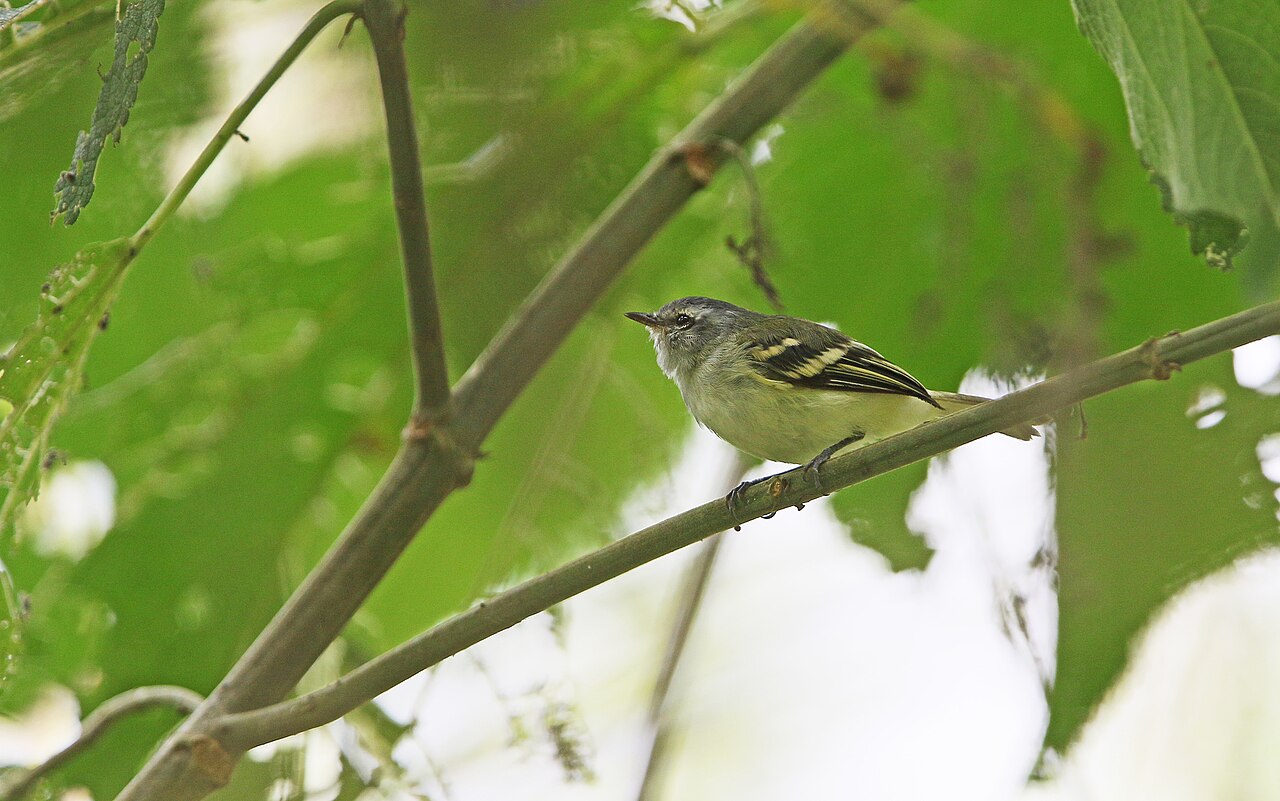
The white-tailed tyrannulet is a species of bird in subfamily Elaeniinae of family Tyrannidae, the tyrant flycatchers. It is found in Colombia, Ecuador, and Peru.
Region
Northern Andes
Typical Environment
Occurs on humid Andean slopes of Colombia, Ecuador, and northern Peru, primarily in cloud forests and montane evergreen forests. It favors forest edges, secondary growth, and areas with abundant epiphytes. Birds often work the midstory to canopy, especially along ridges and stream corridors. It tolerates some habitat disturbance but remains most common in intact montane forest.
Altitude Range
1200–3000 m
Climate Zone
Highland
Ease of Keeping
Beginner friendly: 1/5
A small Andean flycatcher, the white-tailed tyrannulet often joins mixed-species flocks and actively flicks its tail, flashing white outer tail feathers that aid identification. It forages by gleaning and short sallies among mossy limbs in cloud forests. Its subtle plumage is offset by crisp wing bars and a pale supercilium.


Temperament
social and active
Flight Pattern
short rapid wingbeats with brief sallies
Social Behavior
Usually found in pairs or small family groups and readily joins mixed-species foraging flocks. Likely monogamous, with a small cup nest placed in dense vegetation or mossy sites typical of montane forests. Both parents participate in caring for the young.
Migratory Pattern
Resident
Song Description
Song is a series of thin, high-pitched notes and brief trills, often delivered from mid-canopy perches. Calls are sharp, squeaky tsit or tsee notes used to maintain contact within flocks.
Plumage
Olive to gray-olive upperparts with whitish to pale gray underparts; neat, contrasting wing bars and a pale supercilium. The tail shows distinct white on the outer feathers, often revealed by frequent tail-flicking.
Diet
Feeds primarily on small insects and other arthropods gleaned from foliage, twigs, and epiphyte-laden branches. Employs short sallies to snatch prey and probes clusters of moss and bromeliads. May occasionally take tiny spiders and other invertebrates.
Preferred Environment
Forages in the midstory to canopy of humid montane forest, along edges, and in secondary growth with mature trees. Often follows mixed-species flocks along ridgelines and stream borders where insect activity is high.


