

The white-eared monarch, or white-eared flycatcher, is a species of bird in the family Monarchidae. It is endemic to north-eastern Australia. Its natural habitat is subtropical or tropical moist lowland forests. The white-eared monarch was originally described in the genus Monarcha until moved to Carterornis in 2009.
Region
Northeastern Australia
Typical Environment
Occurs in humid lowland and foothill rainforests, vine thickets, and riparian gallery forests of north-eastern Queensland. It frequents dense midstory and edges, especially along streams and in sheltered gullies. Birds may also use secondary growth and rainforest fragments when continuous forest is limited. It is generally sedentary within its localized range.
Altitude Range
Sea level to 600 m
Climate Zone
Tropical
Ease of Keeping
Beginner friendly: 1/5
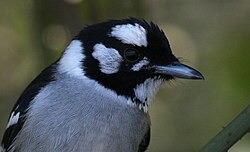
Also known as the white-eared flycatcher, this monarch is endemic to north-eastern Australia and favors humid lowland rainforests. It forages actively by sallying and gleaning insects from foliage. The species was formerly placed in Monarcha and moved to Carterornis in 2009 based on genetic and morphological evidence. Its bold white ear patch makes it one of the easier rainforest monarchs to identify.

Temperament
active and somewhat territorial
Flight Pattern
short rapid wingbeats with quick sallies from perches
Social Behavior
Usually seen singly or in pairs within territories, sometimes joining mixed-species foraging flocks. Builds a small, neat cup nest suspended in a fork or horizontal branch, often over water or in dense foliage. Both sexes participate in nesting duties, including incubation and feeding of nestlings.
Migratory Pattern
Resident
Song Description
A series of clear, thin whistles interspersed with short chips. Calls are used to maintain contact in dense vegetation and can carry well despite being soft.
Plumage
Striking, clean pattern with strong contrast between head and face patch; smooth, sleek feathering typical of monarch flycatchers.
Diet
Feeds primarily on small arthropods such as flies, beetles, moths, caterpillars, and spiders. It takes prey by sallying from low to mid-canopy perches and by gleaning from leaves and twigs. Foraging is deliberate but agile, with frequent short flights to pursue moving prey.
Preferred Environment
Midstory to subcanopy layers of rainforest and along shaded stream corridors. Often forages at forest edges and in vine tangles where insect activity is high.


