
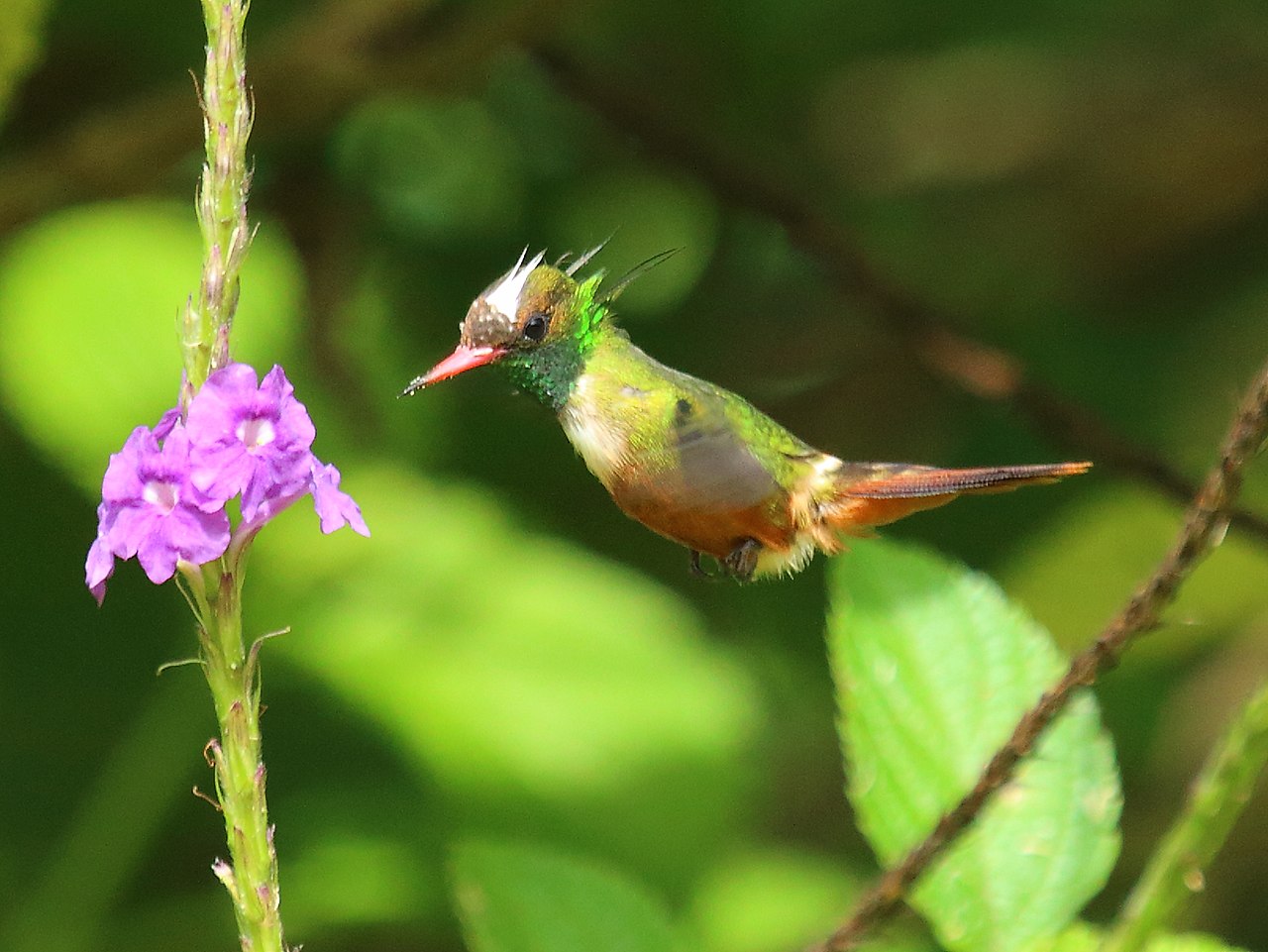
The white-crested coquette is a species of hummingbird in the "coquettes", tribe Lesbiini of subfamily Lesbiinae. It is found in Costa Rica and Panama.
Region
Southern Central America
Typical Environment
Occurs from southern Costa Rica into western Panama, mainly in the Pacific slope foothills and adjacent lowlands. It uses forest edges, semi-open areas, second-growth thickets, and flowering gardens, often where Inga, Erythrina, and other nectar sources are present. Shade coffee and mixed agroforestry with abundant blossoms can support local concentrations. It is generally scarce to uncommon and patchy, tracking seasonal blooms.
Altitude Range
0–1500 m
Climate Zone
Tropical
Ease of Keeping
Beginner friendly: 1/5
A tiny hummingbird of southern Costa Rica and western Panama, the white-crested coquette is famed for the male’s erect, snowy white crest and glittering green plumage. It frequents flowering trees in forest edges, second growth, gardens, and shade coffee. Though generally local and uncommon, it can be conspicuous where favored blossoms are abundant. It supplements nectar with tiny insects for protein.


Temperament
active and territorial
Flight Pattern
short rapid wingbeats with agile hovering
Social Behavior
Usually solitary at flowers but may gather loosely where blooms are dense. Males defend small nectar territories and perform short, darting displays. Nests are tiny cup structures placed on slender horizontal branches, built from plant fibers and spider webs.
Migratory Pattern
Resident
Song Description
Vocalizations are high, thin chips and rapid tsets given during feeding and chases. Wings produce a faint whir during hovering; males may add soft buzzy trills in display.
Plumage
Male is glittering green above with a striking white erectile crest, dark mask, and rufous-tinged tail; underparts whitish to buff with green spangling. Female lacks the crest and facial plumes, shows green upperparts, pale underparts with green spotting on the throat and breast, and a rufous tail with a dark subterminal band.
Diet
Takes nectar from small to medium tubular flowers, including Inga, Erythrina, and various shrubs and epiphytes. Also hawks or gleans minute insects and spiders, especially during breeding. Shifts among flower patches as resources change and may exploit garden ornamentals.
Preferred Environment
Feeds along forest edges, semi-open clearings, second growth, and flowering trees in gardens and shade coffee. Often forages at mid-level to canopy heights, visiting bloom clusters repeatedly.


