

The white-crested helmetshrike, also known as the white helmetshrike, is a species of passerine bird in the Vanga family Vangidae, formerly usually included in the Malaconotidae.
Region
Sub-Saharan Africa
Typical Environment
Occurs widely in savanna and open woodland, including acacia, miombo, and riparian woodlands. It favors edges, secondary growth, and lightly disturbed habitats, and may visit wooded farmland and gardens. The species forages from the lower canopy to midstory, frequently moving between trees in cohesive groups. It avoids dense closed-canopy rainforest but can be common where trees are scattered. Local movements follow rainfall and food availability.
Altitude Range
0–2400 m
Climate Zone
Tropical
Ease of Keeping
Beginner friendly: 1/5
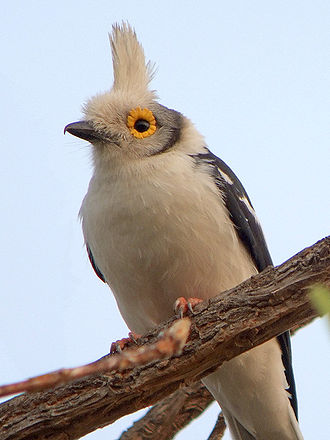
White-crested helmetshrikes are highly social birds that travel in tight-knit parties, often moving through the canopy in coordinated lines. They are cooperative breeders, with group members helping to build nests and feed chicks. The species is notable for its fluffy white crest and bright yellow facial wattles, which make it easy to identify at a distance.


Temperament
social and active
Flight Pattern
short rapid wingbeats between perches with agile sallies
Social Behavior
Forms cohesive groups, often 6–20 birds, maintaining contact with constant calls while moving through trees. They practice cooperative breeding, with multiple adults assisting at a single nest. Groups roost communally and engage in frequent mutual preening and sunning. They mob potential predators vigorously.
Migratory Pattern
Resident
Song Description
Vocalizations are lively and chattering, with squeaky scolds, rattles, and sharp contact notes exchanged within the group. Choruses can build rapidly as the flock becomes excited. Calls carry well in open woodland, aiding in coordination while foraging.
Plumage
Sleek dark grey to black upperparts with contrasting white forehead and a prominent, fluffy white crest. Underparts are largely white with darker breast sides; bold white patches are visible in the wings and often on the rump. Feathers are smooth and close-fitting except for the crest, which is loose and bushy.
Diet
Primarily hunts insects and other arthropods such as beetles, caterpillars, grasshoppers, and spiders. Prey is gleaned from foliage, bark, and twigs, and occasionally caught on short sallies. They may take small vertebrates or berries opportunistically but remain strongly insectivorous. Cooperative flocking helps flush and track prey.
Preferred Environment
Feeds in the midstory and lower canopy of open woodland, especially along edges and in acacia stands. Also forages in riparian trees and scattered trees over savanna or cultivated areas. Uses perches to scan and make short dashes into foliage.


