

The white-cheeked pintail, also known as the Bahama pintail or Bahama duck, is a species of dabbling duck that is patchily distributed throughout South America and the Caribbean. It was first described by Carl Linnaeus in his landmark 1758 10th edition of Systema Naturae under its current scientific name.
Region
Caribbean and northern South America
Typical Environment
Found patchily across the Bahamas, Greater and Lesser Antilles, and along the Caribbean coasts of northern South America, with an insular population in the Galápagos. It favors shallow brackish and saline lagoons, mangrove-fringed bays, salt ponds, and tidal flats, but also uses freshwater ponds and marshes. The species thrives on islands and coastal lowlands with stable shallow water and emergent vegetation. It often forages in sheltered coves and hypersaline basins where competition is lower.
Altitude Range
Sea level to 800 m
Climate Zone
Tropical
Ease of Keeping
Beginner friendly: 3/5
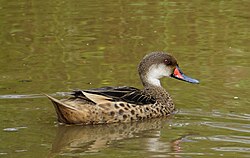
Also called the Bahama pintail, it is well adapted to saline and brackish waters, using salt glands to excrete excess salt. The bold white cheek, red at the bill base, and green speculum make it easy to recognize. It occurs in several subspecies, including an insular form in the Galápagos. Generally wary in the wild, it readily gathers at productive lagoons and salt ponds.



Temperament
social and alert
Flight Pattern
swift, direct flight with rapid wingbeats
Social Behavior
Usually seen in pairs or small groups, forming larger flocks where food is abundant. Nests are placed on the ground near water, often concealed in vegetation; the female incubates while the male remains nearby. Breeding can occur year‑round in tropical areas, linked to rainfall and water levels.
Migratory Pattern
Resident
Song Description
Generally quiet; males give soft, whistled notes and thin wheezy calls. Females produce a harsher, quack-like call, especially when alarmed or communicating with ducklings.
Plumage
Mottled brown body with fine dark spotting; clean white cheeks and throat contrast with a darker crown and nape. Glossy green speculum edged in white is visible in flight.
Diet
Dabbles and filters for seeds of aquatic plants, algae, and tender shoots. Also consumes small aquatic invertebrates, including crustaceans, insect larvae, and mollusks, especially during breeding when protein needs rise. Its lamellate bill and salt glands allow efficient feeding in brackish and saline waters.
Preferred Environment
Forages in shallow margins of lagoons, mangroves, and salt ponds, often where submerged vegetation is accessible. Will also feed in freshwater marshes and man‑made ponds when available.


