

The white-browed owl, also known as the white-browed hawk-owl or the Madagascar hawk-owl, is a species of owl in the family Strigidae. It is endemic to Madagascar.
Region
Madagascar
Typical Environment
Found mainly in western and northern Madagascar, occupying dry deciduous forests, wooded savannas, mangroves, and secondary growth. It also occurs along forest edges, riverine corridors, and sometimes in plantations and village groves. The species favors areas with scattered tall trees for perching and hunting. It is largely absent from the highest montane zones and the most humid interior rainforest.
Altitude Range
Sea level to 1500 m
Climate Zone
Tropical
Ease of Keeping
Beginner friendly: 1/5
Also called the white-browed hawk-owl or Madagascar hawk-owl, this species is confined to Madagascar. It is a versatile nocturnal predator that adapts to dry forests, mangroves, and even human-modified landscapes. Its bold white eyebrow gives it a striking facial expression in torchlight. Despite habitat pressures on Madagascar, it remains relatively widespread and is currently not considered at risk.

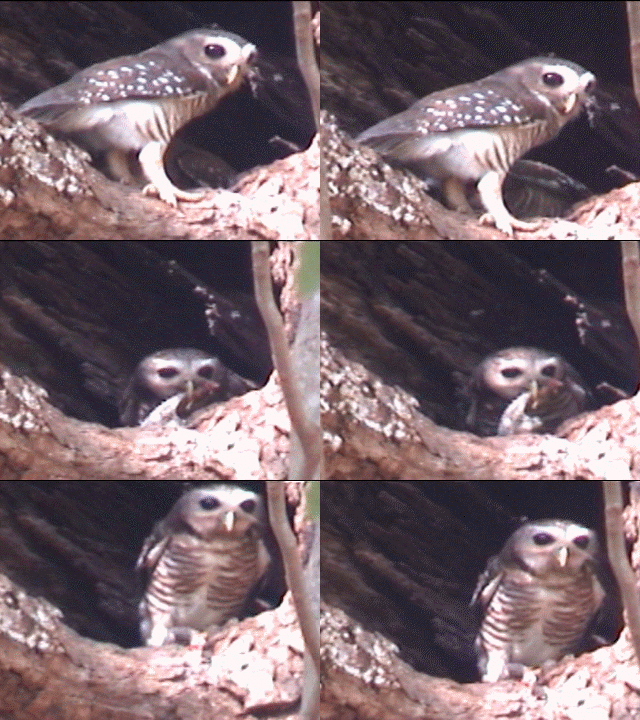
White-browed owl gives food to mate at the Berenty Reserve in 2003
Temperament
solitary and territorial
Flight Pattern
short rapid wingbeats with direct, agile bursts between perches
Social Behavior
Usually encountered alone or in pairs, especially during the breeding season. Nests are typically in tree cavities or natural holes, with both adults attending the young. Pair bonds are monogamous for the season and territories are defended with vocal displays at night.
Migratory Pattern
Resident
Song Description
A series of resonant hoots delivered in steady pairs or short sequences, often carrying far on calm nights. Also gives sharp barks and screeches when agitated near the nest.
Plumage
Warm brown upperparts with fine mottling, pale underparts with brown streaking, and a distinct white supercilium over each eye. Face shows a dusky facial disk without ear tufts, and the tail is barred. Feathers appear dense and smooth, aiding silent flight.
Diet
Primarily hunts large nocturnal insects such as beetles, moths, and katydids. It also takes small vertebrates opportunistically, including geckos, frogs, and small rodents. Hunting is mostly from a perch, dropping onto prey on the ground or snatching it from foliage.
Preferred Environment
Forages along forest edges, clearings, and paths where prey is easier to detect. Frequently hunts near lights in villages or plantations that attract insects. Uses perches with open sightlines to scan for movement.


