

The white-bibbed fruit dove is a species of bird in the family Columbidae.
Region
New Guinea Highlands
Typical Environment
Occurs in montane and hill forests across the central ranges of New Guinea, including mossy forest, mature montane rainforest, and forest edges. It favors fruiting trees in the mid to upper canopy and will use secondary growth where fruit is abundant. The species is generally local but can be fairly common where figs are plentiful. It is typically sedentary within home ranges, with small elevational movements following fruit.
Altitude Range
800–2800 m
Climate Zone
Highland
Ease of Keeping
Beginner friendly: 2/5
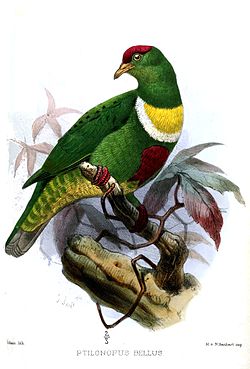
The white-bibbed fruit dove is a canopy-dwelling pigeon of New Guinea’s montane forests, named for its crisp white throat and upper-breast patch. It plays a key role in forest regeneration by dispersing seeds from figs and other fruits. Usually shy and unobtrusive, it is more often heard than seen as it forages quietly among fruiting trees.


Temperament
shy and inconspicuous
Flight Pattern
short rapid wingbeats
Social Behavior
Usually seen singly or in pairs, occasionally in small loose groups at fruiting trees. Nests are small twig platforms placed in dense foliage, with a typical clutch of one egg. Both sexes likely share incubation and chick-rearing duties, as in many fruit doves.
Migratory Pattern
Resident
Song Description
Vocalizations are soft, mellow coos delivered from within canopy cover. Phrases are simple, low-pitched, and repeated at intervals, carrying surprisingly well in dense forest.
Plumage
Predominantly leaf-green with a neat white bib on the throat and upper breast, contrasting with darker green breast sides. Head often shows a faint grayish wash; belly green with yellowish tones and bright yellowish undertail coverts. Females are similar but generally duller and less sharply marked.
Diet
Feeds mainly on small fruits and drupes, especially figs (Ficus), laurels, and other native trees. Swallows fruit whole and later disperses seeds, aiding forest regeneration. Occasionally takes berries from shrubs at forest edges and clearings.
Preferred Environment
Forages in mid to upper canopy of montane and hill rainforests, often at isolated fruiting trees. Will descend to forest edges and secondary growth when fruit is abundant.


