
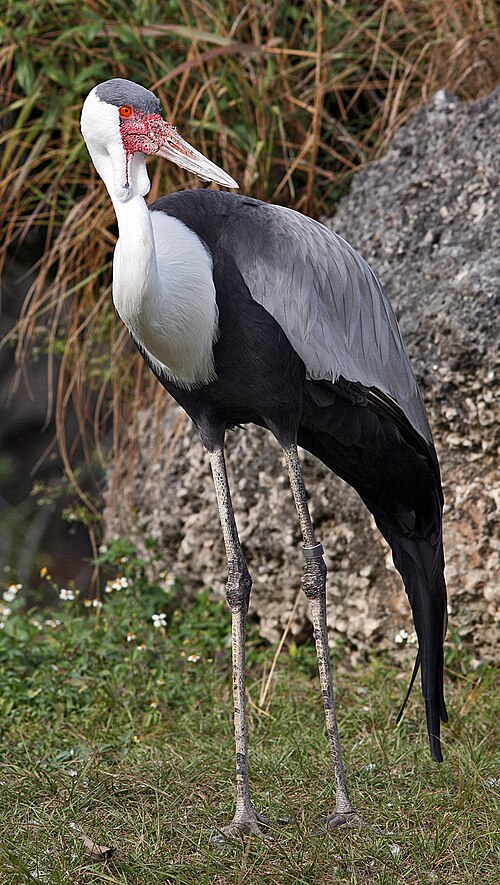
The wattled crane is a large, threatened species of crane found in wetlands and grasslands of eastern and southern Africa, ranging from Ethiopia to South Africa. Some authorities consider it the sole member of the genus Bugeranus.
Region
Eastern and Southern Africa
Typical Environment
This species occurs patchily from Ethiopia and South Sudan south through Zambia, Angola, and the Democratic Republic of the Congo to Botswana, Namibia, Zimbabwe, and South Africa, with its stronghold in the Okavango Delta and Zambian floodplains. It favors expansive shallow wetlands, floodplains, and seasonally inundated grasslands with tall sedges and emergent vegetation. Breeding typically occurs in secluded marshes with stable water levels, where nests are built on matted vegetation. Outside breeding, birds may forage in adjacent damp grasslands and shallow pans, moving locally as water conditions change.
Altitude Range
Sea level to 3000 m
Climate Zone
Subtropical
Ease of Keeping
Beginner friendly: 1/5
The wattled crane is Africa’s largest crane, easily recognized by the paired white wattles that dangle from its throat. It depends on intact seasonal wetlands and floodplains, which makes it highly sensitive to drainage, dams, and altered flooding regimes. Pairs are long-lived and form strong bonds, typically rearing a single chick after a prolonged period of parental care.


A pair foraging in Moremi Game Reserve, Botswana.

At Franklin Park Zoo, Massachusetts, USA. Portrait showing distinctive wattles

displaying wings

flying wattled crane
Temperament
wary and deliberate
Flight Pattern
strong flier with slow, deep wingbeats; often soars on thermals with neck and legs extended
Social Behavior
Wattled cranes are typically seen in pairs or small family groups and maintain large territories during breeding. They build solitary nests in secluded marshes and usually lay one egg, with both parents sharing incubation and chick-rearing. Outside the breeding season, they may gather in small flocks on rich floodplains and communal roosts.
Migratory Pattern
Partial migrant
Song Description
Their call is a loud, resonant bugle or trumpet, often given in synchronized duets by pairs. Contact calls are lower and more guttural, carrying well across open wetlands.
Plumage
Mostly gray body with a striking white neck and upper breast, contrasting black belly and tail coverts, and long black primaries. The throat bears elongated white wattles, and the crown shows a dark cap with some bare reddish facial skin.
Diet
They feed largely on aquatic plant parts, especially sedge rhizomes and tubers (notably Eleocharis), seeds, and bulbs. They also take invertebrates such as insects and mollusks, and occasionally small vertebrates like frogs and small fish. Foraging involves careful probing and digging in soft, inundated soils.
Preferred Environment
Feeding is concentrated in shallow water and saturated soils of floodplains, marsh edges, and seasonal pans. They also forage in damp grasslands adjacent to wetlands when water levels recede, following the shifting margin of inundation.


