

The wattled curassow is a threatened member of the family Cracidae, the curassows, guans, and chachalacas. It is found in remote rainforests in the western Amazon basin in South America. Males have black plumage, except for a white crissum, with curly feathers on the head and red bill ornaments and wattles. Females and juveniles are similar but lack the bill ornamentation and have a reddish-buff crissum area. The wattled curassow is the most ancient lineage of the southern Crax curassows. In captivity, it sometimes hybridises with the blue-billed curassow.
Region
Western Amazon Basin
Typical Environment
Occurs patchily along major white-water rivers and seasonally flooded várzea forests of the western Amazon, including parts of Brazil, Peru, Colombia, and Bolivia. It favors remote river islands, gallery forests, and floodplain edges with abundant fruiting trees. The species generally keeps close to large waterways and oxbow lakes and uses adjacent terra firme edges when fruit is available. Human disturbance and hunting pressure limit it to the most inaccessible tracts.
Altitude Range
0–300 m
Climate Zone
Tropical
Ease of Keeping
Beginner friendly: 2/5
The wattled curassow is an ancient lineage within the southern Crax curassows and plays a key role as a large-bodied seed disperser in Amazonian floodplain forests. Males have striking red bill ornaments and paired wattles, features absent in females. It is highly sensitive to hunting and riverine habitat degradation. In captivity it has occasionally hybridized with the blue-billed curassow.


Head and neck of an adult male

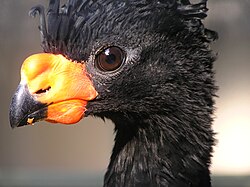


Wattled curassow by J. Smit.

Wattled curassow female at the National Aviary
Temperament
shy and wary
Flight Pattern
short rapid wingbeats; prefers to run and glide rather than sustain long flight
Social Behavior
Usually found in pairs or small family groups. Likely monogamous, with a simple stick platform nest placed in trees above floodwaters. Roosts in trees and spends much of the day walking and foraging quietly on the forest floor. Breeding is timed to seasonal fruiting and river cycles.
Migratory Pattern
Resident
Song Description
The male gives deep, resonant booming notes, often at dawn, that carry through flooded forests. Both sexes may utter soft grunts and low growls when alarmed or interacting at close range.
Plumage
Glossy black overall with a curly crest; males show a clean white crissum while females have a reddish-buff crissum and subtler tones.
Diet
Primarily consumes fallen and low-hanging fruits and large seeds, passing many seeds intact and aiding dispersal. Supplements diet with buds, shoots, and occasionally insects or small invertebrates. Forages deliberately on the ground and at the forest edge, often beneath fruiting trees. During low-water periods it may exploit river islands and sandbar vegetation.
Preferred Environment
Feeds in seasonally flooded várzea and gallery forests near major rivers, along levees, and on river islands. Often stays close to cover but uses open river edges and oxbow margins when fruit is abundant.


