

The metallic starling (Aplonis metallica), also known as the shining starling, is a bird in the starling family native to the Moluccas, New Guinea, Queensland and the Solomon Islands
Region
Sub-Saharan Africa
Typical Environment
Found widely across wooded savannas, forest edges, gallery forests, and riparian woodlands. It favors mosaic landscapes with scattered tall trees that offer cavities for nesting and fruiting resources. The species is common around villages, orchards, and gardens where fruit trees are present. It ranges broadly from West to East and southern Central Africa, with local movements tracking seasonal food.
Altitude Range
0–2200 m
Climate Zone
Tropical
Ease of Keeping
Beginner friendly: 2/5
Also known as the violet-backed or amethyst starling, this species shows striking sexual dimorphism: males are glossy violet-purple above with clean white underparts, while females are brown and heavily streaked. Its iridescent sheen comes from microscopic feather structures rather than pigment. It nests in natural cavities or old woodpecker holes and readily exploits fruiting trees. Outside the breeding season it often joins mixed-species flocks at canopy fruit sources.


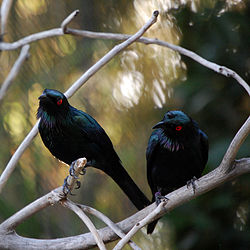
Immature at San Diego Zoo


Temperament
social and active
Flight Pattern
short rapid wingbeats with fast, direct flight
Social Behavior
Often seen in pairs during the breeding season and in small flocks at other times. Nests in tree cavities lined with plant material; the female incubates while the male often helps feed fledglings. Frequently joins mixed flocks at fruiting trees and may forage in the canopy as well as at mid-levels.
Migratory Pattern
Partial migrant
Song Description
A mix of thin, high whistles and sweet, warbling phrases delivered from exposed perches. Calls include sharp, metallic notes used in contact and alarm.
Plumage
Male with glossy, metallic violet-purple head, mantle, and back contrasting with crisp white underparts; female brown above with strong streaking on the head, back, and underparts.
Diet
Eats a varied mix of fruits and arthropods, including figs, berries, beetles, caterpillars, and termites. It often switches seasonally, taking more insects when feeding young. Foraging includes gleaning from foliage and branches, short sallies to snatch flying insects, and raiding fruit clusters. It will visit human-planted fruit trees and forest-edge shrubs.
Preferred Environment
Most often feeds in the canopy and at forest edges where fruiting trees are abundant. Also uses riparian woodland, wooded savanna, and gardens with tall trees. Occasionally descends to lower levels to hawk insects.


